Real-time traffic management depends on reliable information about how vehicles move through a road network. Traffic flow sensors collect this information and convert vehicle movement into usable data such as volume, speed, lane occupancy, headway and queue length.
However, traffic sensors are not interchangeable. Inductive loops, radar, video cameras, magnetometers and LiDAR differ in installation requirements, environmental performance, data output and maintenance needs. Selecting a sensor only by detection range or quoted accuracy can lead to incomplete data, difficult integration or unnecessary lifecycle costs.
This guide explains the main types of traffic flow sensors, the data they provide and the factors system integrators should evaluate before selecting equipment for an intelligent transportation system.
What Is a Traffic Flow Sensor?
A traffic flow sensor is a roadside, overhead or in-pavement device used to detect vehicles and measure traffic movement. Depending on the technology, the sensor may report individual vehicle targets, aggregated lane statistics or both.
Traffic flow sensors are commonly deployed for:
- Highway and arterial traffic monitoring
- Adaptive traffic signal control
- Queue and congestion detection
- Ramp metering
- Tunnel and bridge monitoring
- Travel-time estimation
- Traffic incident detection
- Road planning and statistical analysis
The sensor is only one part of the complete system. Useful traffic data also depends on installation geometry, lane configuration, calibration, communication interfaces and the processing performed by the traffic management platform.
For an explanation of the primary traffic metrics, see our guide to traffic flow, volume, speed, occupancy and headway.
What Data Can Traffic Flow Sensors Provide?
Different sensor technologies provide different levels of information. Before choosing equipment, the project team should define which outputs the traffic controller or management platform actually requires.
Traffic volume
Traffic volume is the number of vehicles passing a defined point during a specified period. It can be reported by lane, direction or vehicle class.
Vehicle speed
Sensors may provide individual vehicle speed, average lane speed or both. Individual speed data is required for applications such as vehicle tracking, enforcement integration and detailed traffic analysis.
Lane occupancy
Occupancy describes how much of a measurement period a detection zone is occupied by vehicles. It is frequently used as an indicator of traffic density and congestion.
Headway and gap
Time headway is the interval between consecutive vehicles. Gap information helps traffic systems evaluate merging opportunities, signal timing and traffic stability.
Queue length
Queue measurement indicates how far slow or stopped traffic extends from an intersection, ramp, toll station or bottleneck.
Vehicle classification
Some sensors can classify vehicles into groups such as passenger cars, vans, buses and trucks. Classification performance depends on the sensing technology, installation geometry and classification model.
Target-level data
Advanced radar and LiDAR sensors may output the position, speed, direction and trajectory of each detected target. This is more detailed than ordinary lane-level statistics and is useful for incident detection, multi-lane tracking and sensor fusion.
Main Types of Traffic Flow Sensors
Radar traffic sensors
Radar sensors transmit radio-frequency signals and analyse the reflected signals from vehicles. Depending on the radar design, the sensor can estimate target range, radial velocity and angle.
Because radar does not depend on visible light, it can operate during the day and at night. It is also less affected by shadows, glare and changes in illumination than a conventional camera.
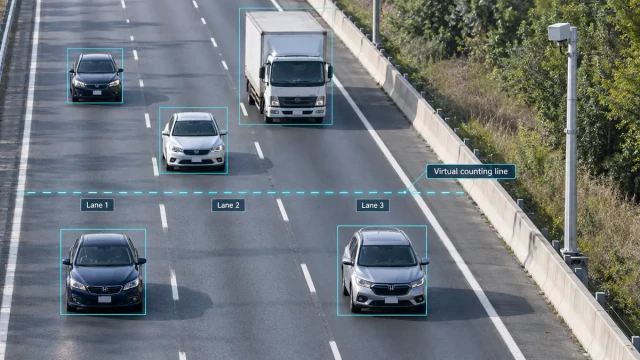
Modern multi-target traffic radar can provide:
- Vehicle presence and count
- Individual and average speed
- Travel direction
- Lane assignment
- Target coordinates and trajectories
- Queue and occupancy information
- Multi-lane traffic statistics
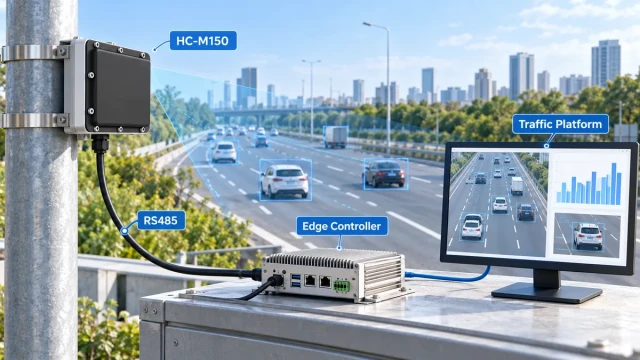
Radar is particularly suitable for non-intrusive installations where road cutting should be avoided. It can be mounted on a pole, gantry or roadside structure and connected to a controller or central traffic platform.
Learn more about the capabilities and selection factors in our guide to radar traffic detectors.
Inductive loop detectors
An inductive loop is installed beneath the road surface. When a vehicle passes over the loop, the metal body changes the loop’s electrical characteristics, allowing the system to detect vehicle presence.
Loops are widely used for intersection control and lane-based vehicle detection. They can provide reliable presence and count data when properly installed.
Their main limitation is installation and maintenance. Cutting the pavement disrupts traffic, and road resurfacing or cable damage may require additional work. A single loop also provides limited information unless several loops are installed in sequence.
Magnetometers
Magnetometers detect changes in the Earth’s magnetic field caused by a vehicle. They may be installed in the pavement or placed in compact wireless housings.
These sensors are useful for vehicle presence, parking detection and basic traffic counting. Compared with larger loop installations, they may require less pavement work, but battery life, wireless communication and access for maintenance must still be considered.
Video traffic sensors
Video detection systems use cameras and image-processing algorithms to identify vehicles and analyse traffic conditions.
Their main advantage is visual information. In addition to count and movement data, cameras can support vehicle classification, lane analysis and visual verification of incidents.
However, video performance depends on a clear field of view. Strong glare, darkness, fog, rain, shadows, lens contamination and vehicle occlusion may affect detection. Projects using video should also consider bandwidth, data storage and privacy requirements.
LiDAR traffic sensors
LiDAR measures distance by analysing reflected laser light. It can create detailed spatial information about vehicles and surrounding objects.
LiDAR can provide accurate position and contour data, which is useful for classification and complex intersection monitoring. Its limitations may include equipment cost, field-of-view requirements and reduced performance under certain weather or contamination conditions.
Infrared sensors
Infrared traffic sensors detect thermal radiation or reflected infrared energy. They are often used for short-range presence detection, pedestrian detection or specialised lane applications.
Their suitability depends on detection distance, mounting position, ambient temperature and environmental conditions. They are generally not a direct replacement for long-range multi-lane radar.
Piezoelectric sensors
Piezoelectric sensors generate an electrical signal when vehicles apply pressure to an embedded strip or cable. They are commonly used for axle detection, vehicle classification and weigh-in-motion systems.
Because they must be installed in or on the road surface, they require traffic control during installation and periodic inspection as the pavement ages.
Traffic Flow Sensor Comparison
| Technology | Installation | Typical output | Main advantage | Main consideration |
|---|---|---|---|---|
| Radar | Pole, gantry or roadside | Speed, count, occupancy, tracks and trajectories | Multi-lane, day-and-night operation | Requires correct mounting and configuration |
| Inductive loop | Embedded in pavement | Presence, count and occupancy | Established lane detection technology | Road cutting and pavement maintenance |
| Magnetometer | In-pavement or wireless | Presence and count | Compact detection point | Battery, communication and road access |
| Video | Pole or gantry | Count, classification and visual evidence | Rich visual information | Lighting, weather, occlusion and privacy |
| LiDAR | Pole or roadside | Position, contour and classification | Detailed spatial measurement | Cost, field of view and environmental exposure |
| Infrared | Roadside or overhead | Presence and short-range detection | Simple specialised detection | Limited range and environmental dependence |
| Piezoelectric | Embedded in pavement | Axles, classification and weight-related data | Useful for axle-based measurements | Intrusive installation and pavement wear |
No technology is universally best. The correct choice depends on the required data, road layout, environmental conditions, installation restrictions and system architecture.
How Radar Measures Traffic Flow
A traffic radar illuminates a road area and receives reflections from vehicles. Signal processing separates targets and estimates their movement.
A radar system may calculate:
- Range from the returned signal
- Speed from Doppler information
- Direction from the sign and pattern of motion
- Angle from the antenna array
- Trajectory by associating detections over time
The radar can then convert individual target tracks into lane-level statistics. For example, target crossings can be counted as traffic volume, while target speed and position can be used to calculate average speed, occupancy and headway.
This distinction is important: target-level radar data provides more flexibility than a sensor that outputs only aggregated totals. Integrators can use the same target stream for several functions, provided the interface and update rate meet the project requirements.
Our traffic flow monitoring solution explains how radar target data can support multi-lane monitoring and traffic platform integration.
Installation Factors That Affect Detection Quality
Even a capable sensor may produce poor results when installed incorrectly.
Mounting location
The sensor needs an unobstructed view of the monitored lanes. Poles, signs, barriers, vegetation and large vehicles can create blind areas or occlusion.
Height and angle
Mounting height and orientation affect the detection area and the separation of adjacent lanes. Installation parameters should follow the manufacturer’s recommended geometry rather than being selected only for convenience.
Road curvature and gradient
Curved roads, ramps and steep gradients can change the relationship between target movement and the sensor. These sites may require different positioning, additional configuration or more than one sensor.
Lane definition
The configured lane boundaries must match the actual road geometry. Incorrect lane regions can cause vehicles to be assigned to the wrong lane and distort lane-level statistics.
Validation
After installation, the sensor output should be compared with a reference count or recorded traffic sample. Validation should cover different lanes, speeds and traffic densities instead of relying on a short observation under ideal conditions.
Integration Requirements for ITS Projects
A traffic flow sensor must exchange data with the rest of the traffic system. Before procurement, integrators should confirm:
- Physical interfaces such as Ethernet, RS485 or serial communication
- Supported network protocols
- Target-level and statistical data formats
- Update rate and reporting interval
- Time synchronisation
- Controller compatibility
- API or protocol documentation
- Remote configuration and diagnostic functions
- Cybersecurity and network access requirements
The difference between “the sensor can detect vehicles” and “the sensor can integrate with the existing platform” is significant. Interface documentation and sample data should be reviewed before large-scale deployment.
How to Select the Right Traffic Flow Sensor
Define the required outputs
Start with the data required by the application. A signal controller that only needs vehicle presence has different requirements from a motorway platform that needs speed, lane occupancy, queue length and individual target trajectories.
Evaluate the number of lanes and detection area
Confirm the required road width, number of lanes, detection distance and mounting position. The quoted maximum range alone does not show whether the sensor can maintain lane separation across the complete monitoring area.
Consider traffic conditions
Dense traffic, stop-and-go movement, large trucks and lane changes make target separation more difficult. The sensor should be evaluated under conditions representative of the actual site.
Consider weather and lighting
Radar is generally preferred when continuous operation is required across day, night and changing illumination. Cameras may be selected when visual verification or image-based classification is essential.
Review installation and maintenance costs
The purchase price is only part of the total cost. Road closures, pavement work, cleaning, recalibration, communications and future replacement should also be included.
Confirm integration before deployment
Request protocol documentation and verify data with the intended controller or management platform. A pilot installation is often more valuable than selecting equipment from a specification sheet alone.
When Is Radar the Better Choice?
Radar is a strong candidate when a project requires:
- Non-intrusive roadside or overhead installation
- Multi-lane vehicle detection
- Individual speed and trajectory data
- Day-and-night operation
- Reduced dependence on visible-light conditions
- Long detection areas
- Connection to an existing traffic management platform
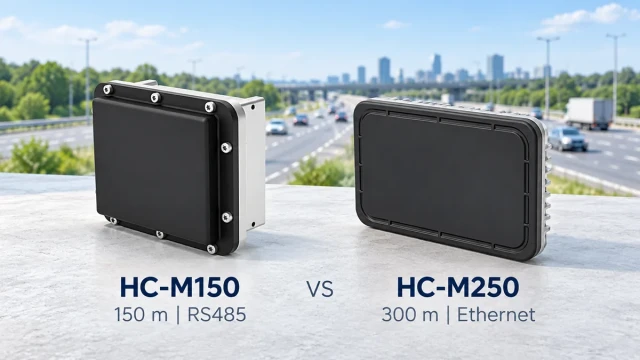
For long-range and multi-lane traffic monitoring, the HC-M250 traffic radar provides target data that can be integrated into traffic monitoring and control systems.
Radar does not eliminate the value of other technologies. Cameras can add visual confirmation, loops can provide simple point detection, and LiDAR can provide detailed spatial profiles. In many projects, the best architecture combines complementary sensors instead of forcing one technology to perform every task.
Frequently Asked Questions
What is the difference between a traffic flow sensor and a speed sensor?
A speed sensor may measure only vehicle speed or speed and direction. A traffic flow sensor normally provides additional information such as count, occupancy, headway, lane assignment or queue length.
Can one sensor monitor several lanes?
Some radar, video and LiDAR systems can monitor multiple lanes from one mounting position. Actual lane capacity depends on the sensor, road width, mounting geometry and traffic density.
Can radar detect stopped vehicles?
Radar systems designed for target tracking can detect stopped or slow-moving vehicles, but the capability must be confirmed for the specific product and installation. Not every Doppler-only speed sensor is suitable for stationary target detection.
Do traffic flow sensors identify drivers?
Most radar traffic sensors measure vehicle movement rather than personal identity. Cameras may capture identifiable images, so video systems require additional privacy, storage and access-control considerations.
Which sensor is best for all-weather traffic monitoring?
Radar is often selected for continuous traffic monitoring because it does not depend on visible light and is generally more resilient to changes in illumination. Final performance still depends on hardware design, installation and environmental severity.
Conclusion
Traffic flow sensors are the foundation of traffic monitoring, signal control and data-driven road management. The correct sensor should be selected according to required outputs, lane geometry, environmental conditions, installation constraints and integration needs—not by a single headline specification.
Radar provides a strong balance of non-intrusive installation, multi-lane coverage and target-level traffic data. Loops, cameras, magnetometers, LiDAR, infrared and piezoelectric sensors remain useful where their specific strengths match the application.
For system integrators, the most important step is to define the required data and interface before selecting hardware. A well-designed pilot installation can then verify detection performance and platform compatibility under real traffic conditions.