A radar traffic detector is a non-intrusive sensor that uses reflected radio waves to detect vehicles and measure traffic conditions. Depending on its waveform, antenna design and signal-processing software, a radar detector can report vehicle presence, speed, direction, distance, lane position, individual tracks and aggregated traffic-flow statistics.
Radar is widely used where pavement cutting is undesirable or where a single roadside sensor must monitor more than one lane. However, not every radar provides the same data. A basic Doppler speed sensor, a presence detector and a multi-target tracking radar may all be described as traffic radar, even though their outputs and suitable applications are very different.
What Is a Radar Traffic Detector?
A radar traffic detector transmits electromagnetic energy toward a defined section of road. Vehicles reflect part of that energy back to the sensor. The radar processes the returned signal to determine whether a vehicle is present and, depending on the product, estimate its speed, range, direction and position.
Traffic radar may be mounted:
- above the road on a gantry or mast arm;
- beside the road on a pole;
- facing approaching or departing traffic;
- at the side of the road looking across multiple lanes.
The mounting direction affects what the radar can measure and how accurately it can associate targets with individual lanes.
How Does Radar Detect Traffic?
Traffic radar uses several measurements derived from the returned signal.
Doppler speed measurement
A moving vehicle changes the frequency of the reflected radar signal. This change is known as Doppler shift. The radar uses it to measure the component of vehicle speed along the radar line of sight.
Doppler measurement is useful for detecting moving vehicles and measuring speed. A simple continuous-wave sensor may not directly measure target range and may not detect a stationary vehicle.
Range measurement
FMCW radar changes the transmitted frequency over time. By comparing the transmitted and received signals, the detector can estimate target range as well as speed.
Range information allows the system to define detection zones, distinguish vehicles at different distances and detect both moving and stationary targets when the radar and processing software support presence detection.
Angle and lane-position measurement
Radar systems with multiple antenna channels can estimate the direction from which a reflection arrives. Range and angle measurements can then be converted into road coordinates.
The system can use these coordinates to associate a vehicle with a lane, monitor lane changes and maintain a target track through the detection area.
What Data Can a Radar Traffic Detector Provide?
Available outputs vary by model. Common outputs include:
- vehicle presence or passage;
- approaching or departing direction;
- individual vehicle speed;
- range and lateral position;
- lane assignment;
- target ID and trajectory;
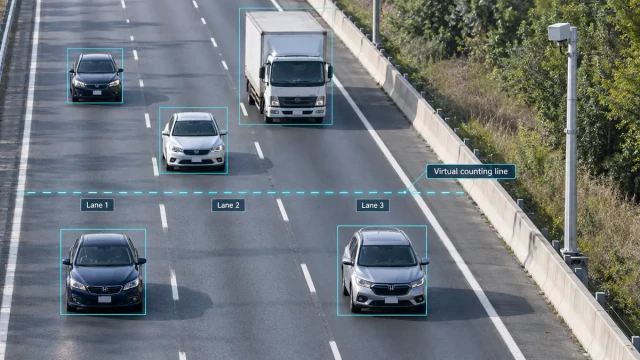
- vehicle count by lane and direction;
- average speed;
- occupancy;
- headway and gap;
- queue length or stopped-vehicle events;
- basic length-based vehicle classification.
Buyers should distinguish individual vehicle records from aggregated traffic statistics. A detector that reports one-minute average speed and volume does not necessarily provide the position and speed of every vehicle. Conversely, a target-list radar may require an external controller to calculate traffic statistics.
CW, FMCW and Multi-Target Tracking Radar
| Radar type | Typical capability | Important limitation |
|---|---|---|
| CW Doppler radar | Measures the speed and direction of moving targets | Does not directly measure range and may not detect stopped vehicles |
| FMCW presence radar | Measures range and speed and can support presence zones | Lane separation and classification depend on antenna design and processing |
| Multi-target tracking radar | Outputs coordinates, speed, direction, target ID and trajectories | Requires site calibration, lane mapping and suitable integration software |
MIMO describes an antenna and processing architecture rather than a separate traffic measurement objective. Multiple transmit and receive channels can improve angular resolution, but actual lane separation and tracking performance must still be validated at the intended installation site.
Where Are Radar Traffic Detectors Used?
Traffic-flow monitoring
Radar can provide lane-by-lane vehicle count, speed, occupancy, headway and other flow data. These measurements support road-operation monitoring, congestion analysis and traffic planning.
For a complete example, see the traffic flow monitoring solution.
Speed measurement and camera triggering
A radar detector can measure vehicle speed and send a trigger or target message to a camera controller. Multi-lane applications may also require vehicle coordinates, lane information and a persistent target ID so the correct image can be matched to the correct radar track.
Intersection detection
Presence-capable radar can create detection zones for approaching, waiting or departing vehicles. These zones may provide inputs to a traffic controller for signal actuation, queue monitoring or approach detection.
A simple moving-target Doppler radar should not be assumed to provide reliable stopped-vehicle presence at a signalized intersection.
Wrong-way and incident detection
Direction and trajectory data can be used to identify vehicles moving against the permitted traffic direction. Tracking radar can also support stopped-vehicle, slow-vehicle or abnormal-trajectory alerts when the detection area and event rules are configured correctly.
Tunnels, bridges and work zones
Radar is useful where lighting varies, pavement work is difficult or temporary detection is required. It may support speed monitoring, queue warning and traffic-state collection without embedding sensors in the road surface.
Forward-Looking and Side-Looking Installation
Forward-looking radar
A forward-looking radar faces generally along the direction of traffic. This geometry provides a strong radial-speed component and is well suited to individual vehicle speed and trajectory measurement.
Vehicles in the same line of sight may partially hide one another, so mounting height, lateral offset and road curvature must be considered.
Side-looking radar
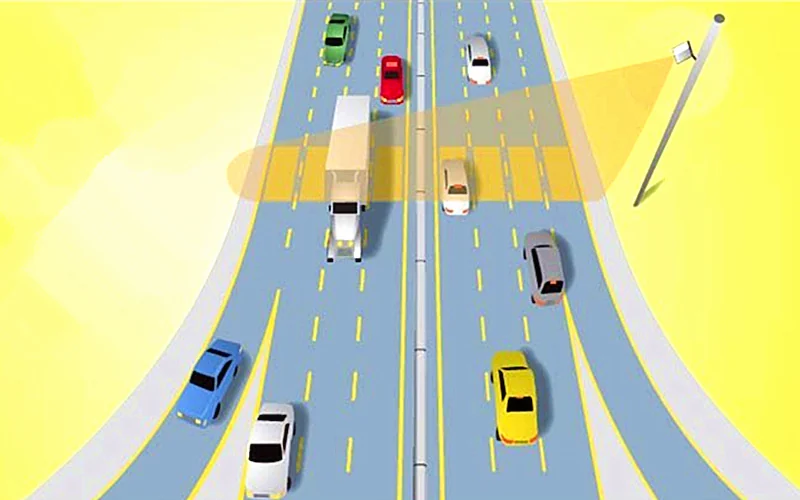
A side-looking radar observes traffic across the road. One sensor may cover several lanes and generate lane-based flow statistics.
Because adjacent vehicles may overlap from the radar’s viewpoint, dense traffic and large trucks can cause occlusion. Accurate aiming and detection-zone calibration are especially important when monitoring several lanes from the roadside.
Radar Traffic Detectors vs Inductive Loops
| Comparison | Radar detector | Inductive loop |
|---|---|---|
| Installation | Mounted above or beside the road | Embedded in the pavement |
| Lane closure | May be limited to mounting and commissioning work | Normally required for cutting and repairing pavement |
| Coverage | One unit may cover several lanes or detection zones | Loops are normally installed for each required lane or zone |
| Speed measurement | Can measure speed directly using Doppler information | Usually requires two loops or estimation using occupancy |
| Road resurfacing | May require recalibration but the sensor is not embedded in the pavement | Resurfacing can damage or require replacement of the loop |
| Commissioning | Requires aiming, coordinate setup and zone calibration | Requires correct loop geometry and controller configuration |
Radar Traffic Detectors vs Video Detection
Video can provide visual evidence and detailed appearance-based classification. Radar provides direct speed information and does not depend on visible illumination.
Camera performance can be affected by glare, shadows, headlight bloom, fog, precipitation or a dirty lens. Radar can also be affected by installation geometry, occlusion, multipath reflections and strong stationary structures.
Radar and video are often complementary. Radar can provide speed, distance and trajectory, while the camera provides images and visual classification. A fusion system must synchronize time and coordinate systems before it can reliably associate tracks with images.
Radar Traffic Detectors vs Lidar
Lidar uses laser light to obtain precise distance and spatial information. It can produce detailed target contours or point clouds, depending on the device.
Radar generally provides strong direct speed measurement and good operation across changing light conditions. Lidar may provide denser spatial information but can be more sensitive to fog, blowing snow and contamination of its optical window.
The correct choice depends on whether the project prioritizes speed and long-range tracking, detailed object shape, classification or sensor fusion.
Can Radar Detect Stationary Vehicles?
It depends on the radar waveform and processing method.
- A basic CW Doppler sensor detects motion and normally cannot identify a vehicle that remains stationary.
- An FMCW presence detector can use range information to identify stationary objects within configured zones.
- A tracking radar may maintain a stopped target, but its track-management logic and timeout settings must be checked.
This distinction is critical for queue detection, stop-line presence, stopped-vehicle alarms and tunnel incident detection.
What Affects Radar Detection Performance?
Mounting angle
Radar measures radial speed. If the radar beam and vehicle direction are not aligned, the measured radial component differs from actual road speed. Installation geometry and any angle compensation must match the site.
Occlusion
A truck or bus may block smaller vehicles behind it. Higher mounting positions and carefully selected viewing angles can reduce, but not always eliminate, this problem.
Multipath reflections
Guardrails, tunnel walls, signs and large metal structures can produce additional reflections. Detection zones and tracking parameters should be tested under actual site conditions.
Road geometry
Curves, grades, merging lanes and lane-width changes affect coordinate mapping. A radar configured for a straight road should not be moved to a different geometry without recalibration.
Traffic density
Dense traffic increases the number of simultaneous targets and the likelihood of partial occlusion. Buyers should verify target capacity and tracking continuity under representative peak traffic.
How to Select a Radar Traffic Detector
Start with the required data, not the longest advertised range. Ask the following questions:
- Must the detector report moving vehicles, stopped vehicles or both?
- Is the application traffic counting, speed measurement, signal control or incident detection?
- How many lanes and directions must one sensor cover?
- Are individual target coordinates and trajectories required?
- What is the maximum number of simultaneous targets?
- Does the system need lane-level statistics or raw target messages?
- Will the radar be mounted forward-looking, overhead or side-looking?
- Which communication interface and message format does the controller require?
- How will the radar, camera and controller clocks be synchronized?
- What field tests will be used for acceptance?
Choosing Between HC-M150 and HC-M250
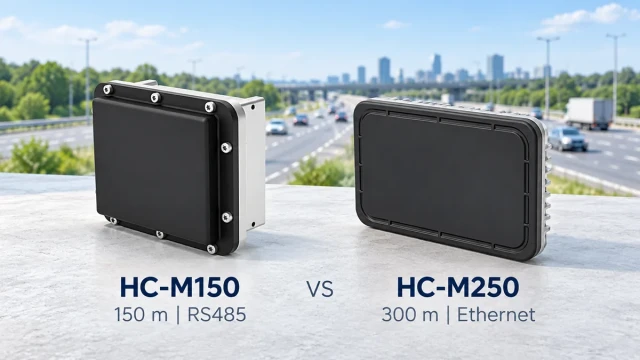
The HC-M150 multi-lane traffic radar is intended for applications that require vehicle speed, coordinates and trajectory data across multiple lanes within a defined road section.
The HC-M250 long-range traffic radar is intended for longer monitoring corridors and traffic-flow applications where extended detection distance and multi-target tracking are required.
The final choice should be based on road geometry, required detection distance, number of targets, output interface and field-validation results.
Integration and Data Interfaces
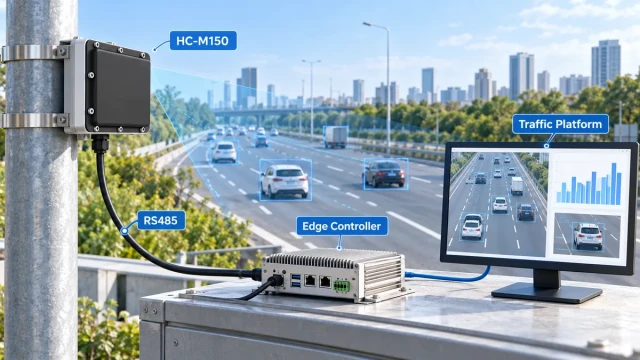
A radar detector is only one component of the complete system. Before integration, confirm:
- coordinate units and coordinate origin;
- speed units and direction convention;
- lane numbering rules;
- target creation and deletion logic;
- timestamp format and clock synchronization;
- update rate and communication latency;
- status, fault and heartbeat messages;
- network, serial or controller interface requirements.
A technically accurate radar can still produce unusable system results if the controller interprets its coordinates, direction or target IDs incorrectly.
How to Validate a Radar Installation
Commissioning should include more than checking whether vehicles appear on the software screen. A practical test plan should verify:
- vehicle count by lane and direction;
- speed against a suitable reference device;
- lane assignment near lane boundaries;
- tracking continuity during overtaking and lane changes;
- performance with cars, motorcycles, vans and trucks;
- dense traffic and partial occlusion;
- stopped or slow vehicles when required;
- communication recovery after power or network interruption;
- camera triggering and target-to-image association.
Acceptance thresholds should be defined before testing. Results should be evaluated separately for each required output instead of using one general “accuracy” figure.
Common Questions
Do radar traffic detectors work at night?
Yes. Radar is an active radio-frequency sensor and does not depend on visible road illumination. Night operation does not remove the need for correct installation and calibration.
Can one radar monitor several lanes?
Many traffic radar systems can cover multiple lanes, but the number of usable lanes depends on range, field of view, mounting geometry, angular resolution, traffic density and target-processing capacity.
Can traffic radar classify vehicles?
Some radar detectors provide basic length-based or track-based classes. Radar-only classification should not automatically be treated as equivalent to visual or axle-based classification. The required classes must be validated with representative vehicles.
Is traffic radar completely unaffected by weather?
No sensor is completely unaffected by its environment. Radar normally performs well in changing light and common roadside weather, but heavy precipitation, radome contamination, multipath and installation conditions can still affect signal quality.
Can a radar traffic detector replace a camera?
Radar can replace a camera for some detection and measurement tasks, but it does not provide the same visual evidence. Enforcement, plate recognition and visual vehicle identification normally require a camera or another imaging sensor.
Summary
Radar traffic detectors provide non-intrusive vehicle detection and can measure speed, presence, range, position and traffic-flow parameters. Their actual capability depends on the waveform, antenna design, signal processing and output interface.
Successful deployment requires matching the detector to the required data, road geometry and mounting position. The installation must then be calibrated and validated under representative traffic conditions. Selecting a radar by advertised range alone is not enough.
References
- FHWA Traffic Detector Handbook: Sensor Technology Characteristics
- FHWA Traffic Detector Handbook: Microwave Radar Installation
- FHWA Traffic Monitoring Guide: Data Collection Technologies