
Wavetronix SmartSensor is a family of non-intrusive radar detectors developed for traffic monitoring and signalized-intersection applications. The name does not refer to one universal sensor: SmartSensor HD, Matrix and Advance use different detection geometries and are intended to solve different roadway problems.
For traffic engineers and system integrators, the important question is therefore not simply whether a sensor uses radar. The selection should be based on the required application, mounting position, detection area, output data, controller interface and validation method.
What Is Wavetronix SmartSensor?
Wavetronix uses the SmartSensor name for several roadway radar products. According to the manufacturer’s published documentation, the main models serve three distinct purposes:
- SmartSensor HD: side-fire traffic monitoring across multiple lanes.
- SmartSensor Matrix: stop-bar presence detection at signalized intersections.
- SmartSensor Advance: forward-looking advance detection and dilemma-zone protection.
These applications require different radar coverage patterns and different types of output. A detector designed to produce lane-by-lane traffic statistics is not automatically suitable for stop-bar presence detection, and an advance detector is not necessarily the correct choice for permanent traffic data collection.
SmartSensor HD: Multi-Lane Traffic Monitoring
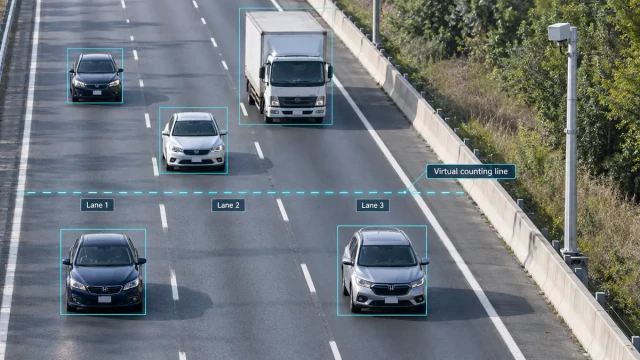
SmartSensor HD is described by Wavetronix as a side-fire dual-beam ITS sensor. It is normally installed beside the roadway and observes traffic moving across its detection area.
The manufacturer states that SmartSensor HD can detect as many as 22 lanes within a detection range of 250 ft. Its published outputs include individual-vehicle speed, length and classification. This makes the product relevant to applications such as:
- Freeway and arterial traffic monitoring
- Vehicle counting and lane-based statistics
- Average-speed and occupancy measurement
- Vehicle classification
- Traffic management and planning systems
Side-fire installation can allow one roadside sensor to cover several lanes without cutting the pavement. However, final performance still depends on mounting height, offset, road width, barriers, lane geometry and the degree to which large vehicles obscure smaller targets.
SmartSensor Matrix: Stop-Bar Presence Detection
SmartSensor Matrix is intended for signalized intersections. Its main job is to determine whether moving or stopped vehicles are present in configured detection zones near the stop bar.
Official product information describes Matrix as a 16-beam stop-bar sensor with two-dimensional coverage. It has a 90-degree field of view extending up to 140 ft and can report the presence of both moving and stationary vehicles.
Typical applications include:
- Replacing or supplementing inductive-loop detection
- Stop-bar vehicle presence detection
- Left-turn and approach-lane detection
- Queue and long-zone detection
- Traffic-signal actuation
For this type of project, detecting stopped vehicles is especially important. A radar that measures only moving targets may be suitable for traffic statistics but unsuitable for holding a signal call when a vehicle remains stationary.
SmartSensor Advance: Dilemma-Zone Detection
SmartSensor Advance uses a forward-looking installation geometry. It tracks vehicles approaching a signalized intersection and continually estimates their arrival time at the stop bar.
Wavetronix states that the standard Advance sensor provides detection out to 600 ft. The Extended Range version is designed to extend truck and bus detection to 900 ft under the specified application conditions.
The sensor is primarily associated with:
- Advance vehicle detection
- Dynamic estimated-time-of-arrival tracking
- Dilemma-zone protection
- Queue detection and clearance
- Actuated warning and signal-control systems
This application differs from ordinary speed measurement. The system must combine target distance, speed, trajectory and stop-bar position to determine whether a vehicle may require protection during a signal-phase change.
SmartSensor Model Comparison
| Model | Primary application | Typical geometry | Main output purpose |
|---|---|---|---|
| SmartSensor HD | Multi-lane traffic monitoring | Side-fire | Traffic data and individual-vehicle measurements |
| SmartSensor Matrix | Stop-bar detection | Intersection corner or roadside coverage | Moving and stopped vehicle presence |
| SmartSensor Advance | Advance and dilemma-zone detection | Forward-looking | Vehicle tracking, ETA and controller calls |
The published specifications above describe different products and should not be treated as interchangeable. The final model must match the actual traffic-control or data-collection task.
What Data Should a Traffic Radar Provide?
Radar selection should begin with the data required by the receiving system. Depending on the application, a project may need one or more of the following:
- Vehicle presence
- Per-vehicle speed
- Range and lateral position
- Lane assignment
- Target trajectory
- Traffic volume
- Average speed
- Occupancy and headway
- Vehicle length or classification
- Configurable detection-zone events
Aggregated traffic statistics and target-level radar data are not the same. A traffic-management platform may only require five-minute lane statistics, while a camera-control, enforcement or sensor-fusion system may require real-time target coordinates and trajectories.
How to Evaluate a Wavetronix SmartSensor Alternative
An alternative traffic radar should not be selected from detection range alone. Before changing sensor platforms, system integrators should compare the following factors.
1. Application and installation geometry
Confirm whether the project requires side-fire monitoring, forward-looking tracking or stop-bar presence detection. The sensor position and radar field of view must suit the roadway layout.
2. Output data and update rate
Determine whether the host system needs statistical data, individual targets, event outputs or all three. Target update rate and processing latency can be important for camera triggering and real-time control.
3. Interface compatibility
Check the electrical and communication interfaces, message protocol, time synchronization, controller logic and network architecture. A radar with suitable detection performance may still require integration work if its output format differs from the existing system.
4. Congestion and occlusion performance
Closely spaced vehicles, queues, lane changes, large trucks, roadside barriers and curved roads can all affect detection. Representative site testing is more useful than relying only on a maximum-range figure.
5. Commissioning and maintenance
Compare mounting tolerances, alignment tools, configuration software, remote diagnostics, firmware management and replacement procedures. These factors influence the long-term operating cost of a traffic-monitoring station.
6. Site acceptance criteria
Define how performance will be verified before installation. Tests should use synchronized reference data and clearly specify the required accuracy for counts, speed, lane assignment, presence or target tracking.
WaveLogic Radar for Traffic System Integration
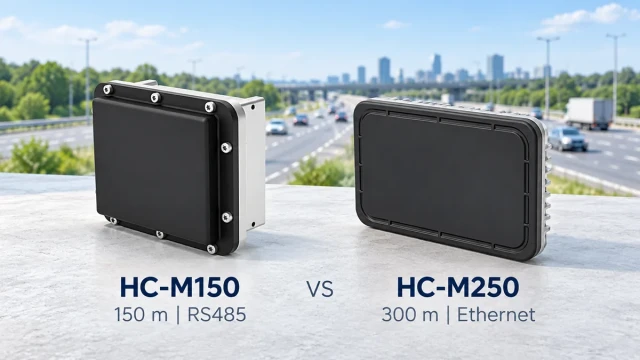
Projects that require long-range, target-level traffic data can also evaluate the WaveLogic HC-M250 traffic radar. It is designed for multi-lane vehicle detection and supplies target information for traffic monitoring, road coordination and system-integration applications.
The correct comparison depends on the required output. The HC-M250 should not be treated as an automatic drop-in replacement for every SmartSensor model. Instead, system integrators should compare the detection geometry, target data, interfaces and controller requirements of the specific project.
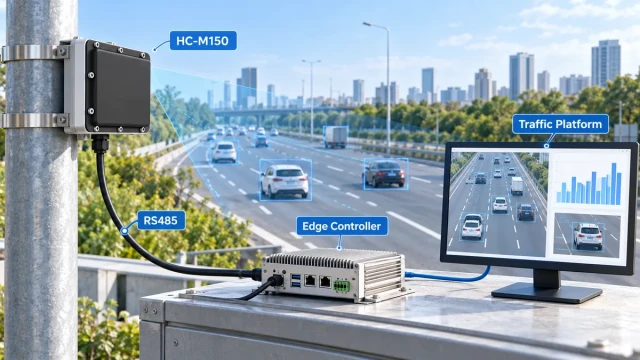
For a broader explanation of system architecture and traffic-data outputs, see the traffic flow monitoring solution.
Frequently Asked Questions
Is Wavetronix SmartSensor the same as RTMS?
RTMS is commonly used as a generic description for a remote traffic microwave sensor, although it has also appeared in commercial product naming. SmartSensor is Wavetronix’s product-family name. SmartSensor HD performs a similar broad category of non-intrusive traffic monitoring, but its specifications and interfaces are product-specific.
Which SmartSensor detects stopped vehicles?
SmartSensor Matrix is specifically designed to report the presence of moving and stopped vehicles in intersection detection zones. This capability is important for stop-bar and signal-actuation applications.
Which SmartSensor is intended for traffic statistics?
SmartSensor HD is the model aimed primarily at multi-lane ITS traffic monitoring and individual-vehicle measurement.
Which SmartSensor is used for dilemma-zone protection?
SmartSensor Advance is intended for forward-looking approach detection and dynamic estimated-time-of-arrival tracking near signalized intersections.
Can another radar directly replace a SmartSensor?
Not automatically. Detection range alone does not establish compatibility. The replacement must be checked for installation geometry, stopped-target capability, data output, controller interface, configuration method and site-acceptance requirements.
Conclusion
Wavetronix SmartSensor HD, Matrix and Advance address three different traffic-detection problems. HD focuses on multi-lane traffic data, Matrix on stop-bar presence, and Advance on approaching-vehicle tracking and dilemma-zone protection.
When evaluating SmartSensor or an alternative traffic radar, begin with the application and required output rather than the product name. A project-specific comparison of geometry, target data, interfaces and field validation provides a more reliable basis for selection.
Wavetronix and SmartSensor are trademarks of their respective owner. Product characteristics cited in this article are based on publicly available manufacturer documentation and should be confirmed against the current project-specific datasheet.