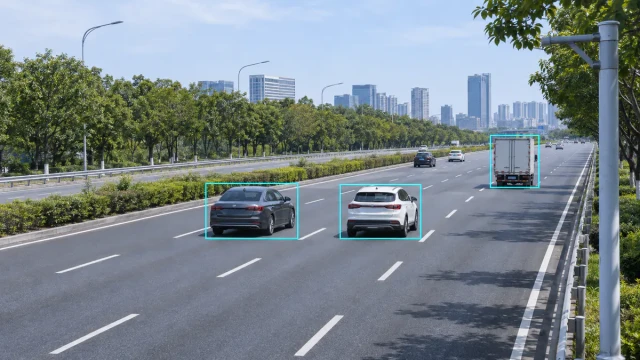
Roadside traffic systems often need more than a simple vehicle count. Depending on the application, the system may need to detect vehicle presence, measure speed, identify the occupied lane, estimate position or continuously track several vehicles at the same time. A properly selected radar sensor for vehicle detection can provide these measurements without cutting into the pavement and without relying on visible light.
This guide focuses specifically on infrastructure-mounted radar used beside or above the road. It explains how to define the detection task, evaluate radar output, plan installation and connect the sensor to traffic controllers, cameras or monitoring platforms.
What Is a Radar Sensor for Vehicle Detection?
A vehicle detection radar is an active sensor that transmits radio-frequency signals and analyses the returned reflections from vehicles. Depending on its waveform, antenna design and signal-processing method, the radar may provide one or more of the following outputs:
- Vehicle presence or passage events
- Approaching or receding direction
- Vehicle speed
- Range and lateral position
- Lane assignment
- Target trajectory
- Traffic volume, average speed, occupancy or headway statistics
These outputs are not interchangeable. A sensor intended only to trigger a sign has different requirements from a multi-lane radar supplying target coordinates to a traffic management system. The first step is therefore to define what the downstream system actually needs.
Start With the Required Detection Output
Before selecting a radar, separate the project requirements into detection, measurement and communication functions.
| Project requirement | Required radar output | Typical use |
|---|---|---|
| Vehicle presence | Occupied or clear status | Signal control, gate activation or warning systems |
| Vehicle passage | Trigger event and direction | Counting and event activation |
| Speed measurement | Target speed with time reference | Speed feedback and enforcement integration |
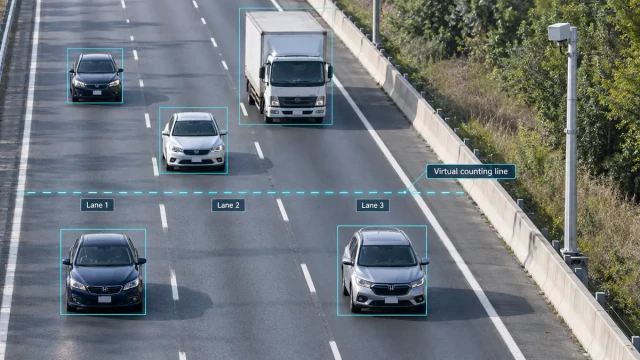
| Lane-level monitoring | Lane assignment and traffic statistics | Multi-lane traffic monitoring |
| Continuous tracking | Target ID, position, speed and trajectory | Camera association and intelligent traffic systems |
A project specification should also state the number of lanes, traffic direction, required detection zone, minimum and maximum operating speeds, expected vehicle types, output update rate and communication interface.
How Roadside Vehicle Detection Radar Works
Radar determines information about a target by analysing the transmitted signal and the echo reflected from the vehicle. Motion creates a frequency change known as the Doppler effect, while modulated radar waveforms can also estimate target range.
For roadside applications, the processing chain generally includes:
- The radar transmits a defined waveform into the detection area.
- Vehicles reflect part of the transmitted energy.
- The receiver measures characteristics of the returned signal.
- Signal processing separates valid targets from background reflections.
- Tracking logic associates measurements over time.
- The radar outputs events, target data or traffic statistics to the external system.
A basic motion radar may be suitable when the system needs only speed or a movement trigger. Applications requiring range, lane position or continuous target tracking usually need a radar architecture designed to provide target-level data.
Moving and stationary vehicle detection
Do not assume that every radar detects stopped vehicles in the same way. A motion-only detector may depend primarily on Doppler information, while a ranging radar can potentially maintain targets with little or no relative speed. If queue detection, stop-line presence or stationary vehicle monitoring is required, this function should be confirmed during product evaluation and site testing.
Presence Detection Versus Multi-Target Tracking
Presence detection answers a simple question: is a vehicle occupying a defined area? Multi-target tracking provides a continuing estimate of individual vehicle movement.
A tracked target record may contain:
- A temporary target identifier
- Longitudinal and lateral position
- Speed and movement direction
- Lane assignment
- Time stamp or update sequence
- Target status or confidence information
This distinction matters when integrating radar with cameras. A single trigger can tell a camera when to capture an image, but reliable association between a particular vehicle and its image may require position, time and trajectory information.
For a broader comparison of detector technologies and radar types, see our guide to radar traffic detectors.
Installation Geometry Determines Performance
Radar performance depends on more than the sensor specification. Mounting height, horizontal offset, aiming angle, road curvature, elevation changes, barriers, signs and large vehicles can all affect the usable detection area.
The Federal Highway Administration notes that the footprint of an over-roadway sensor depends on mounting height, offset, aperture, road geometry and objects that may obstruct the field of view. It also recommends evaluating candidate sensors under real operating conditions before a large deployment.
Forward-looking installation
In a forward-looking arrangement, the radar observes vehicles travelling toward or away from the sensor. This configuration can support longer observation zones and continuous tracking, but lane separation and target association must be verified at the actual mounting position.
Side-looking installation
A side-looking radar observes vehicles across the road. It can be useful for traffic statistics and compact roadside installations. However, vehicles in nearer lanes may obscure smaller vehicles in farther lanes, particularly in dense traffic. The radar model and processing method must therefore be evaluated for the intended number of lanes.
Overhead installation
An overhead position can provide a clearer view of multiple lanes, but it requires suitable gantries, mast arms or other structures. Installation access, cable routing, grounding, lightning protection and future maintenance should be considered during system design.
Common Site Factors That Affect Detection
A site survey should identify conditions that may create missed targets, incorrect lane assignment or unwanted detections.
- Occlusion: trucks or buses may block smaller vehicles from the radar view.
- Road curvature: vehicles may enter and leave the radar beam at different positions.
- Elevation changes: slopes can change the effective detection footprint.
- Guardrails and structures: strong stationary reflections may require careful aiming and configuration.
- Adjacent roads: traffic outside the intended lanes may enter the detection area.
- Vibration: an unstable pole or mounting bracket can affect the relationship between the radar coordinate system and the road.
- Mixed traffic: motorcycles, passenger cars, trucks and closely spaced vehicles should all be included in validation testing.
Manufacturer installation guidance should take priority over generic mounting rules because antenna patterns and tracking algorithms differ between radar models.
Connecting Radar to a Traffic System
A successful installation requires both physical communication and a clear definition of the data exchanged between systems.
Event-based output
Event-based output is suitable when a controller needs a simple trigger, such as vehicle present, vehicle passed or speed threshold exceeded. The integration should define the trigger condition, hold time, reset logic and behaviour when communication is lost.
Target-level output
Target-level data is more suitable for applications involving lane assignment, continuous tracking or association with camera records. The integrator should confirm:
- Coordinate origin and axis direction
- Measurement units
- Update rate and communication latency
- Time-stamp format
- Target creation and deletion logic
- Target ID behaviour
- Invalid-data and communication-loss handling
A target identifier should not automatically be treated as a permanent vehicle identity. It is normally a temporary tracking reference created by the radar system.
Traffic statistics
Some radars calculate traffic volume, average speed, occupancy and headway internally. Others provide target data and leave statistical processing to the external platform. Confirm where aggregation occurs and how intervals, lane definitions and exceptional events are handled.
Radar and Camera Integration
Radar and cameras perform different roles. Radar can provide speed, range and trajectory information, while a camera can provide visual context and evidence. Combining them requires more than connecting two devices to the same network.
The integration design should establish:
- A shared or convertible time reference
- The relationship between radar coordinates and camera view
- The trigger or association rule
- How simultaneous vehicles are separated
- How records are stored and retrieved
- What happens when one sensor becomes unavailable
For projects focused on speed measurement and image capture, see our speed enforcement integration solution.
How to Validate a Vehicle Detection Radar
Validation should be performed at the intended site or at a representative test location. A short test with light traffic is not enough for a multi-lane deployment.
The test plan should include:
- Free-flowing and congested traffic
- Different lanes and travel directions
- Passenger cars, motorcycles and large vehicles
- Closely spaced and overtaking vehicles
- Low-speed, stopped and accelerating vehicles where relevant
- Day and night operation
- Rain or other locally important weather conditions
- Communication interruption and recovery
Compare radar output with an independent reference method. The acceptance criteria should be defined before testing and should match the application: presence accuracy, count accuracy, speed error, lane assignment, track continuity and output latency are separate measurements.
Choosing the Right Radar for the Project
Use the following questions to narrow the selection:
- Does the system need a trigger, traffic statistics or individual target tracks?
- Must it detect stopped or very slow vehicles?
- How many lanes and directions must be covered?
- What mounting positions are available?
- Which vehicle types must be detected?
- What interface and protocol does the controller support?
- Does the project require camera association?
- How will field performance be verified?
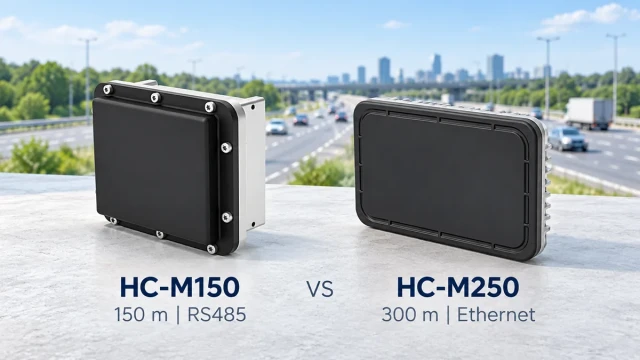
WaveLogic provides traffic radar products for different roadside detection tasks. The HC-M150 traffic radar is designed for multi-lane target detection and tracking, while the HC-M250 long-range traffic radar supports applications requiring a longer observation area. Product selection should be based on the site geometry, required data and integration architecture.
For traffic statistics and roadway monitoring architecture, visit our traffic flow monitoring solution.
Frequently Asked Questions
Can radar detect vehicles at night?
Radar does not depend on visible illumination, so its measurement principle can operate during daytime and nighttime. Actual system performance still depends on installation geometry, configuration and environmental conditions.
Can one radar monitor several lanes?
A multi-target traffic radar may cover several lanes, but the supported lane count and effective detection area depend on the radar model, mounting position, road geometry and traffic conditions. These should be verified at the project site.
Can radar detect stopped vehicles?
Some radar systems can maintain or detect stationary targets, while motion-only detectors may not provide the same capability. Stopped-vehicle or queue-detection requirements must be confirmed for the selected model.
Does vehicle detection radar replace a camera?
Not necessarily. Radar provides measurement and tracking data, while cameras provide visual information. Many systems use radar alone for detection or statistics and combine radar with cameras when visual verification is required.
What is the difference between a vehicle detector and a tracking radar?
A basic vehicle detector normally provides presence or passage information. A tracking radar continuously reports target-level data such as position, speed and trajectory, which supports more advanced integration.
Conclusion
Selecting a radar sensor for vehicle detection starts with defining the required output—not simply choosing a detection distance. Presence detection, speed measurement, traffic statistics and continuous multi-target tracking place different demands on the sensor and the integration platform.
Mounting geometry, road layout, target occlusion, communication protocol and validation methods should all be considered before deployment. When these factors are addressed together, roadside radar can provide dependable vehicle data for traffic monitoring, control and camera-based systems.