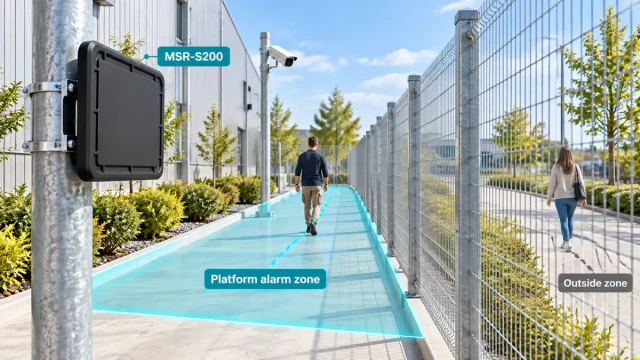
Security radar is a sensing device used to detect and track moving targets around restricted areas. Instead of producing a conventional image, it measures reflected radio signals and converts them into target information such as position, speed, direction and movement trajectory.
In a perimeter protection system, this target data can help answer several important questions:
- Where is the target?
- In which direction is it moving?
- Has it entered or crossed a protected zone?
- How long has it remained in the area?
- Which camera should be used for visual confirmation?
Security radar is therefore not simply another motion detector. It can provide continuous target tracks that allow a security platform to apply virtual boundaries, zone rules and response procedures.
However, radar is not a complete security system by itself. A practical deployment normally combines radar with cameras, alarm-management software, fences, access control and trained operators.
What Is Security Radar?
Security radar is designed for surveillance, perimeter detection or intrusion monitoring rather than traffic enforcement or navigation.
Many compact security radars use frequency-modulated continuous-wave, or FMCW, technology. The radar transmits radio-frequency signals and receives reflections from people, vehicles or other objects.
Signal processing can use these reflections to estimate:
- Target distance
- Radial speed
- Horizontal position
- Direction of movement
- Movement history
- Target trajectory
The available output depends on the radar model. Some devices provide only event information, while others output target IDs, coordinates, speed and tracks to an external security platform.
Radar does not need visible light to measure movement. It can therefore operate during the day or at night without relying on scene illumination. Actual performance still depends on installation geometry, obstructions, environmental conditions, target characteristics and system configuration.
How Does Security Radar Work?
A typical security radar processing chain includes several stages.
1. Radio-signal transmission
The radar transmits a controlled radio-frequency waveform into the monitored area.
2. Echo reception
People, vehicles, fences, walls, vegetation and other objects reflect part of the transmitted energy back toward the radar.
3. Range and velocity processing
The signal processor evaluates characteristics of the returned signal to estimate target distance and radial velocity.
4. Angle estimation
Phase differences across the radar’s antenna channels are processed to estimate the direction of the target.
5. Detection and tracking
Successive detections are associated over time. The radar or host processor assigns a target ID and maintains a continuing track containing position, speed and movement direction.
6. Platform evaluation
The security platform compares the target track with configured zones, virtual boundaries and event rules. It can then notify an operator, create an alarm or coordinate a compatible camera.
This distinction is important: the radar measures and tracks the target, while the integrated platform determines what the movement means for the protected site.
Detection Is Not the Same as Identification
Radar can establish that a target is present and provide information about how it is moving. It does not normally provide the visual detail needed to identify a person, read a vehicle plate or confirm clothing and appearance.
Cameras perform those visual tasks more effectively.
A layered system can therefore use:
- Radar for detection and continuous position tracking
- A visible-light or thermal camera for visual confirmation
- Security software for zones and event logic
- Access-control data for authorization checks
- Operators for final assessment and response
When the integration supports it, the security platform can use radar coordinates to direct a PTZ camera toward the target. The operator then receives both movement information and visual evidence.
Radar and cameras should consequently be treated as complementary sensors rather than competing replacements.
Security Radar Compared with Other Perimeter Sensors
Visible-light cameras
Cameras provide visual detail and recorded evidence, but their performance depends on field of view, lighting, image contrast and obstructions.
Radar does not provide the same visual information, but it can measure position and motion without ambient light. Combining both technologies provides detection data and visual verification.
Thermal cameras
Thermal cameras can detect temperature contrast in darkness and are useful for perimeter surveillance. Their performance can still vary with weather, background temperature, target contrast and scene geometry.
Radar adds independent range, speed and trajectory information.
Passive infrared sensors
PIR sensors are useful for short-range motion detection but usually provide limited information about exact target position and trajectory.
Radar is more suitable when the system requires continuing tracks across a larger monitored area.
Fence-mounted sensors
Fence sensors can detect vibration, cutting or climbing at the physical boundary. They usually detect the event when the target reaches the fence.
Radar can monitor an approach corridor before the target reaches the protected boundary. A project may use both technologies as separate detection layers.
What Data Can a Perimeter Radar Provide?
A target-data interface may include:
- Target ID
- X/Y coordinates
- Distance
- Speed
- Direction
- Trajectory
- Tracking status
- Timestamp
This data allows the host platform to maintain a map of moving targets and evaluate their relationship to protected areas.
For example, different rules can be created for:
- Approaching the perimeter
- Entering a warning zone
- Crossing a virtual line
- Moving in a prohibited direction
- Remaining inside an area
- Exiting a controlled corridor
The exact alarm logic depends on the host platform and project requirements. Integrators should confirm whether the selected radar outputs raw detections, tracked targets, alarm events or a combination of these data types.
Typical Security Radar System Architecture
A perimeter radar project commonly follows this workflow:
- The radar detects a moving target.
- The radar maintains the target ID, coordinates, speed and trajectory.
- Target data is transmitted to the host platform.
- The platform compares the track with zones and virtual boundaries.
- A rule creates an alarm or pre-alarm event.
- A compatible camera is directed toward the target.
- The operator verifies the event and follows the site response procedure.
The platform may also store the target track, event time, camera recording and operator response for later review.
For a more detailed system-level explanation, see our perimeter security radar solution.
Where Is Security Radar Used?
Prison perimeters
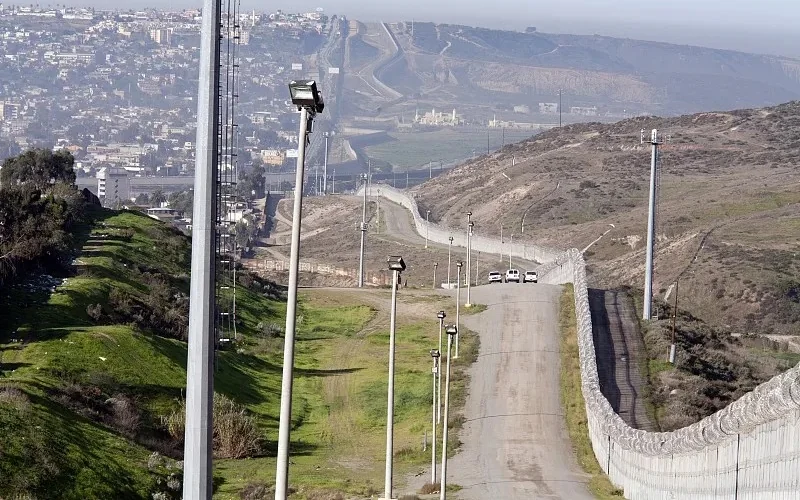
Radar can monitor isolation corridors, walls, fences and other controlled areas. Continuous target tracks help the platform evaluate approach, entry, crossing and exit events.
Critical infrastructure
Power facilities, energy sites, communications facilities and restricted compounds may require early awareness around long boundaries or open areas.
Industrial sites
Factories, warehouses and logistics facilities can use radar to monitor yards, loading areas and site edges outside normal operating hours.
Ports and restricted compounds
Radar can contribute target position and movement data where operators need to monitor large outdoor areas and coordinate multiple cameras.
Solar farms and remote facilities
Large sites may contain long fence lines and limited lighting. Radar can provide an additional detection layer, subject to suitable site geometry and network access.
Different applications require different radar designs. A personnel-detection radar should not automatically be assumed to detect small drones, distant vehicles or every target class. Those requirements must be confirmed separately.
Factors That Affect Detection Performance
Security radar performance is not determined by maximum range alone.
Target type
People, vehicles, animals and small objects reflect different amounts of radio energy. Detection range may therefore be specified separately for different target classes.
Direction of movement
Some radar configurations are more sensitive to movement across the radar field than movement directly toward or away from the device.
Line of sight
Walls, buildings, terrain, dense vegetation and other solid objects can block or weaken the signal and create radar shadows.
Multipath reflections
Metal fences, walls, vehicles and buildings may reflect radio signals along multiple paths. This can affect target position and detection stability if the site is not configured correctly.
Mounting position
Mounting height, downward angle, horizontal direction and distance from the protected area influence coverage.
Weather and environment
Radar does not depend on ambient light and is generally suitable for outdoor operation. Heavy precipitation, accumulated water, moving vegetation and other environmental conditions can still influence performance.
System configuration
Detection thresholds, tracking settings, zones and event rules must match the actual site. Poor configuration can create missed detections or unnecessary alarms.
Radar Shadows and Obstructions
Security radar should normally have a clear view of the area it is intended to monitor.
A solid object inside the coverage area can create a blind region behind it. Examples include:
- Buildings
- Walls
- Containers
- Large vehicles
- Trees
- Dense bushes
- Terrain changes
A metal fence may also affect the radar signal. It should not be assumed that every radar can reliably detect through every fence material.
For complex sites, several radars or overlapping detection layers may be required. A site survey and field validation are more reliable than selecting equipment from the maximum-range specification alone.
Reducing False and Unnecessary Alarms
No security sensor can guarantee zero false alarms. Radar performance can be improved through suitable installation and system logic.
Useful measures include:
- Positioning the radar away from moving vegetation
- Excluding public roads and normal work areas
- Using separate warning and alarm zones
- Applying direction and crossing rules
- Requiring a minimum track duration
- Adjusting thresholds for the expected target
- Verifying radar events with cameras
- Testing operation in representative weather and site conditions
The objective is not simply to generate fewer alerts. It is to generate alerts that correspond to a clear security rule and can be verified efficiently.
Selecting a Security Radar
Before selecting a radar, compare the specifications that determine whether it fits the project.
Detection range
Confirm the specified range for the required target type. A vehicle range should not be used as the personnel-detection range.
Field of view
Check horizontal coverage, elevation coverage and the shape of the effective detection area.
Minimum detection distance
A radar designed for longer distances may still require additional sensors near the mounting position.
Target capacity
Confirm how many targets the radar can track simultaneously and how it behaves when the target count exceeds that limit.
Update rate
The update rate affects how frequently the host system receives target-position changes.
Position and speed accuracy
Review the measurement accuracy required for zone rules, boundary crossing and camera coordination.
Communication interface
Confirm the physical interface, network protocol, target-data structure and integration documentation.
Environmental rating
Check enclosure protection, operating temperature, power supply, surge protection and field-cabling requirements.
Platform compatibility
Confirm how the radar connects to the alarm platform, video-management system and PTZ cameras.
MSR-S200 Perimeter Security Radar
The MSR-S200 perimeter security radar is designed to provide personnel target data along protected perimeter corridors.
Its published capabilities include:
- Personnel detection up to 200 metres
- Tracking for up to 32 targets
- Target coordinates, speed and trajectories
- Ethernet communication using TCP
- 100 ms data update time
- IP67 enclosure
MSR-S200 supplies front-end target information. The connected security platform normally handles virtual boundaries, zone rules, alarm management, map display and camera-assisted verification.
Final coverage should be validated against perimeter length, corridor width, fence and wall geometry, vegetation, mounting position and obstructions.
Information to Prepare Before a Perimeter Radar Project
System integrators should prepare the following information:
- Perimeter length and shape
- Corridor or isolation-zone width
- Required personnel detection distance
- Walls, fences and access points
- Buildings, trees and other obstructions
- Proposed mounting locations
- Existing cameras and video platform
- Network and power availability
- Required alarm rules
- Expected target count
- Data and communication requirements
These details are more useful for product selection than a range number by itself.
Frequently Asked Questions
Does security radar work at night?
Yes. Radar measurement does not depend on visible light. It can continue detecting movement in darkness, although installation conditions and obstructions still affect performance.
Can security radar replace cameras?
Usually not. Radar provides position and movement information, while cameras provide visual detail and recorded evidence. A combined system is generally more useful.
Does the radar directly output an intrusion alarm?
That depends on the product and system design. MSR-S200 outputs target data, while the connected platform normally applies zones, virtual boundaries and alarm rules.
Can radar detect through walls or fences?
Solid objects can block the radar signal and create blind areas. Fence performance depends on material, structure, angle and radar design. It must be tested at the actual site.
Is security radar unaffected by weather?
Radar does not depend on ambient light and is suitable for outdoor sensing, but no sensor is completely unaffected by environmental conditions. Heavy precipitation, moving vegetation, water, obstructions and multipath reflections may influence performance.
Can every security radar detect drones?
No. Ground-personnel radar and drone-detection radar have different antenna, waveform, tracking and classification requirements. Drone detection must be specified separately.
How does radar work with a PTZ camera?
The radar supplies target position and movement data to the security platform. If the platform and camera support the required integration, the system can direct the PTZ camera toward the tracked target for visual verification.
Conclusion
Security radar adds continuous target-position and movement data to a perimeter protection system.
Its main role is to detect and track targets, while the integrated security platform interprets those tracks through zones, virtual boundaries and response rules. Cameras then provide the visual information required for verification.
A successful project depends on more than maximum detection range. Target type, field of view, mounting position, obstructions, communication interfaces and alarm workflow must all be evaluated together.
For projects involving prisons, industrial sites or critical facilities, review the perimeter security radar solution and provide the site layout, corridor width, required detection distance and host-system requirements for technical evaluation.