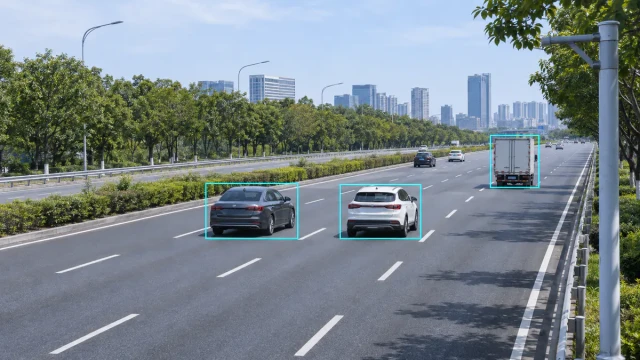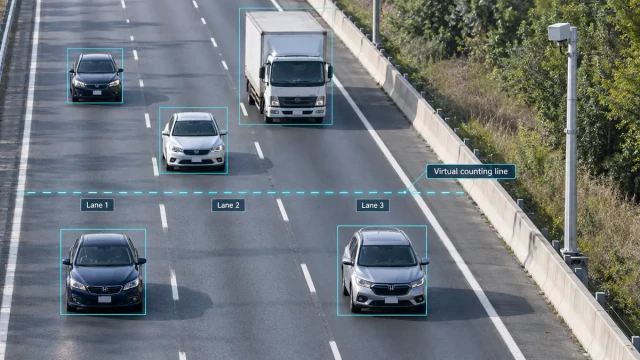
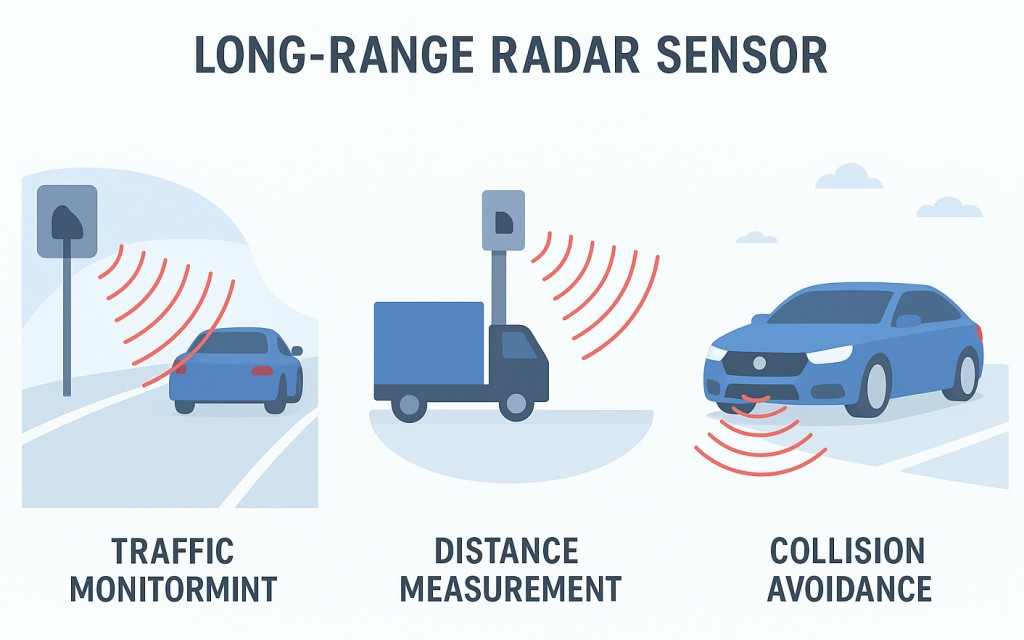
A long-range radar sensor detects and tracks targets at distances beyond the coverage of ordinary short-range presence detectors. In roadway applications, it can provide vehicle distance, speed, lane position and trajectory data before a target reaches a camera, measurement line or traffic-control point.
Maximum range is only one part of radar performance. A sensor that detects a large truck at a long distance may not detect a small passenger vehicle at the same distance with the same reliability. Range, accuracy, resolution, field of view, target capacity and update rate must therefore be evaluated together.
What Is a Long-Range Radar Sensor?
“Long range” is an application description rather than a universal technical category. The required distance depends on the project.
For one installation, 100 metres may provide sufficient warning time. A highway monitoring or camera-control project may require target tracking over several hundred metres. Automotive long-range radar and fixed roadside radar may operate over similar distances, but they solve different problems.
- Vehicle-mounted radar moves with the vehicle and commonly supports adaptive cruise control, collision warning and automatic emergency braking.
- Roadside traffic radar has a fixed coordinate system and monitors vehicles moving through a road section, detection zone or measurement line.
A roadside system may need to track many vehicles simultaneously, assign them to lanes and transmit target data to an external traffic-management, camera or enforcement platform.
What Determines Radar Detection Range?
Radar detection range is influenced by the entire sensing system, not by operating frequency alone.
Transmit power and antenna gain
Transmit power and antenna directivity influence the energy reaching the target. A higher-gain antenna concentrates energy into a narrower region, which can improve long-distance detection but may reduce the field of view.
Target radar cross section
Radar cross section describes how strongly a target reflects energy back toward the sensor. A large truck normally produces a stronger radar return than a motorcycle or small object.
A published maximum distance is incomplete unless it identifies the target type and detection conditions used to obtain the result.
Receiver sensitivity and processing gain
The receiver and signal-processing chain must distinguish weak target echoes from thermal noise, interference and environmental clutter. Coherent processing across multiple chirps can improve detection, but longer processing intervals may affect update rate and latency.
Waveform and sampling configuration
For FMCW radar, chirp slope, sampling rate and processing bandwidth influence maximum measurable range and range resolution. The theoretical unambiguous range is not necessarily the same as reliable field detection distance.
See FMCW Radar Range and Velocity Measurement for the relationship between chirps, beat frequency and range processing.
Installation geometry
Mounting height, horizontal angle, road slope, lane width, roadside offset and target direction all affect the usable detection area. An incorrectly aligned long-range radar may have a good laboratory range specification but poor lane assignment in the field.
Environment and obstruction
Radar is less dependent on ambient light than a camera, but it is not completely unaffected by the environment. Heavy precipitation, water films, mounting vibration, barriers, vegetation, large vehicles and multipath reflections can influence performance.
Maximum Range, Reliable Range and Unambiguous Range
Several different quantities may be described simply as “range.” They should be separated during product evaluation.
Maximum measurable range
This is the limit imposed by waveform timing, beat-frequency processing and sampling configuration. Measurements beyond this limit may become ambiguous or fall outside the processed frequency range.
Maximum detection range
This is the greatest distance at which the radar can detect a specified target under stated conditions. It depends on target reflectivity and the detection threshold.
Reliable operating range
This is the distance over which the radar meets the project’s required detection probability, position accuracy, speed accuracy and target-tracking stability.
The reliable operating range is the most useful specification for an ITS project. It should be validated using representative vehicles, traffic density and installation geometry.
Range Accuracy and Range Resolution
Accuracy and resolution describe different capabilities.
- Range accuracy describes how close a measured distance is to the target’s reference distance.
- Range resolution describes the ability to separate two targets that are close together in range.
An individual vehicle may be measured with acceptable range accuracy even when two adjacent vehicles cannot be resolved as separate targets. Conversely, fine range bins do not guarantee accurate coordinates if calibration, angular estimation or target association is poor.
For an ideal linear FMCW waveform, range resolution is primarily related to transmitted bandwidth:
ΔR ≈ c / 2B
where c is the speed of light and B is the sweep bandwidth.
Increasing FFT size may provide finer displayed bins, but it does not create physical range resolution beyond the available waveform bandwidth.
Angular Resolution Becomes Critical at Long Range
At long distance, a small angular error can create a large lateral-position error. This is particularly important when the radar must distinguish vehicles in adjacent lanes.
For example, a target can have a stable range measurement but still be assigned to the wrong lane if the radar’s angular resolution, calibration or mounting alignment is insufficient.
Long-range multi-lane radar should therefore be evaluated for:
- Azimuth accuracy
- Angular resolution
- Lateral-position stability
- Lane-assignment accuracy
- Performance during lane changes
- Separation of closely spaced vehicles
A maximum-distance claim alone says very little about the radar’s ability to support lane-level traffic applications.
Speed Measurement at Long Distance
Radar obtains radial velocity from the Doppler shift or from phase progression across consecutive chirps. The measured radial velocity is the component directed along the radar line of sight.
When a vehicle travels at an angle θ relative to the radar beam:
vr = v cos(θ)
Long-range speed measurement therefore depends on installation geometry and angle compensation. For lane-level applications, the radar may combine target position, road direction and tracking history to estimate vehicle speed along the roadway.
Testing should compare radar speed with a synchronized calibrated reference at several distances and lanes, not only at one point directly in front of the sensor.
Target Tracking and Update Rate
A long-range radar normally observes a vehicle for more than one measurement frame. Tracking algorithms associate detections over time and maintain a target ID, position, speed and trajectory.
Useful target-level output may include:
- Target ID
- Longitudinal distance
- Lateral position
- Radial or road-aligned speed
- Movement direction
- Lane assignment
- Trajectory
- Target length or classification
- Tracking confidence
Update rate and latency are important when radar data controls a camera or generates a real-time event. A long detection distance provides little benefit if the output is delayed, unstable or difficult to associate with the correct vehicle.
Long-Range Radar Installation Options
Forward-looking installation
A forward-looking radar observes vehicles travelling generally toward or away from the sensor. This arrangement can provide a strong radial-speed component and a long observation path.
It is commonly used for:
- Target tracking
- Speed measurement
- Camera triggering
- Advance warning
- Queue detection
Road curvature, elevation changes and overhead structures must be considered because targets can leave the radar beam before reaching the expected measurement point.
Side-fire installation
A side-mounted radar observes vehicles across the road. One sensor may cover several lanes and generate lane-level traffic statistics.
Side-fire installation can simplify maintenance because the sensor is accessible from the roadside. However, large vehicles can hide smaller vehicles, and the lateral separation of distant lanes may require strong angular or range resolution.
FHWA guidance notes that both forward-looking and side-fire radar arrangements are used for roadway monitoring, with installation geometry affecting the resulting traffic data.
Traffic Monitoring Applications
Highway traffic-flow monitoring
Long-range traffic radar can provide vehicle counts, average speed, occupancy, headway and lane-level target data. These outputs support traffic-management centres, congestion analysis and variable traffic-control systems.
Queue and stopped-vehicle detection
A radar capable of stationary-target detection can identify slow or stopped vehicles and estimate queue development. A basic CW Doppler radar may only detect moving targets, so stopped-target capability must be confirmed.
Camera control and radar-video fusion
Target coordinates can trigger a fixed camera or direct a PTZ camera toward an event. Radar provides distance and speed information, while the camera supplies visual verification.
Speed-enforcement integration
A long-range radar can detect and track vehicles before they reach the image-capture zone. The system must maintain correct association between measured speed, vehicle position, trigger event and evidence image.
See the speed enforcement integration solution for the complete measurement and camera workflow.
Wrong-way and incident detection
Movement direction and trajectory data can support wrong-way vehicle alerts. Sudden stopping or abnormal trajectories may also be passed to an incident-detection system for further evaluation.
Long-Range Radar Compared with Cameras
Radar and cameras provide different types of information.
| Requirement | Radar | Camera |
|---|---|---|
| Direct range measurement | Available | Normally estimated from calibration or multiple views |
| Direct radial-speed measurement | Available | Normally calculated from image movement |
| Visual vehicle identification | Not available by itself | Available when image quality is sufficient |
| Dependence on ambient light | Low | Requires adequate illumination or imaging support |
| Target-to-image evidence | Requires integration | Provides the image component |
Many ITS systems combine radar and video. Radar detects and tracks the target, while the camera confirms vehicle appearance, lane and event context.
How to Select a Long-Range Radar Sensor
A project specification should define more than one maximum-distance value. Important requirements include:
- Required reliable operating range
- Reference target type at maximum distance
- Forward-looking or side-fire installation
- Road width and number of lanes
- Range and angular resolution
- Range, speed and lateral-position accuracy
- Stopped-target detection
- Maximum simultaneous target count
- Target update rate and output latency
- Lane assignment and trajectory output
- Communication interface and message format
- Environmental and enclosure requirements
- Configuration and remote diagnostic tools
The acceptance test should use actual road geometry and representative targets. It should include passenger vehicles, trucks, lane changes, dense traffic and the farthest required detection area.
WaveLogic Long-Range Traffic Radar
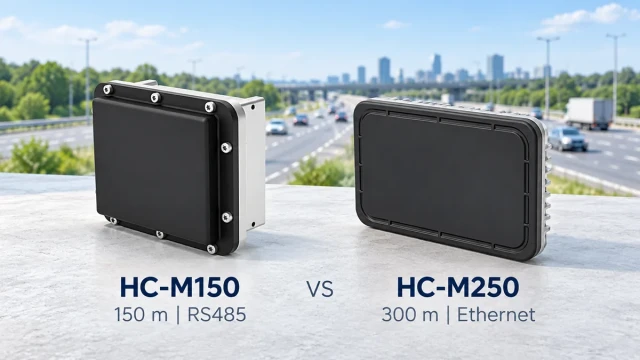
The WaveLogic HC-M250 traffic radar is designed for long-range, multi-lane vehicle detection and target tracking. It provides target data for traffic monitoring, road coordination and system-integration applications.
The radar can be evaluated where a system requires vehicle speed, position and trajectory information rather than only a simple presence output. Final suitability should be confirmed against the required mounting geometry, target type, output interface and acceptance criteria.
For system-level architecture, see the traffic flow monitoring solution and 3D Traffic Radar for ITS.
Frequently Asked Questions
How far can a long-range radar sensor detect?
There is no universal distance. Detection range depends on target reflectivity, transmit power, antenna gain, receiver sensitivity, waveform, processing gain and installation conditions. The specified distance should always identify the reference target and required detection performance.
Does a higher radar frequency always provide longer range?
No. Frequency influences wavelength, antenna size, Doppler sensitivity and propagation behaviour, but maximum reliable range depends on the complete radar design and target conditions.
Is maximum range the same as range resolution?
No. Maximum range describes how far the radar can measure or detect. Range resolution describes how well it can separate two targets at similar distances.
Can long-range radar monitor multiple lanes?
Yes, if the field of view, angular resolution, target capacity and installation geometry support the required road width. Lane-assignment performance should be verified during the site test.
Can long-range radar detect stopped vehicles?
Some FMCW and target-tracking radars can detect stationary targets. Basic CW Doppler radar normally requires target movement. The capability must be confirmed for the specific sensor.
Can a long-range radar replace a camera?
Radar can provide target distance, speed and trajectory but cannot supply visual evidence by itself. Radar and cameras are often combined when a system requires both measurement and vehicle imagery.
Conclusion
A long-range radar sensor should be selected by reliable target performance rather than the largest distance shown in a brochure. Range, angular resolution, speed accuracy, target capacity, update rate and installation geometry all affect whether the radar can produce useful ITS data.
For traffic monitoring and enforcement integration, the most important result is not simply detecting a distant reflection. The system must maintain the correct vehicle track, lane, speed and position from initial detection to the required control or image-capture point.