Loop Detector vs. Radar: Choosing the Right Traffic Sensing Technology
In the world of Intelligent Transportation Systems (ITS), the “eyes” of the road are what keep traffic flowing smoothly. For decades, the Inductive Loop Detector was the unchallenged king of the intersection. However, the rise of Microwave Radar technology has sparked a heated debate among urban planners and civil engineers.
If you are deciding between these two for a municipal project or private infrastructure, understanding the technical nuances, long-term costs, and environmental impacts is crucial.
1. What is an Inductive Loop Detector?
An inductive loop is essentially a wire buried in the pavement. It works on the principle of electromagnetism. When a large metal object (like a car) passes over the loop, it increases the inductance, signaling to the traffic controller that a vehicle is present.
Pros:
-
High Precision for Presence: Excellent at detecting exactly when a car is sitting at a stop bar.
-
Industry Standard: Most technicians are intimately familiar with their repair and integration.
-
Immune to Weather: Since they are underground, fog, snow, or rain doesn’t affect their vision.
Cons:
-
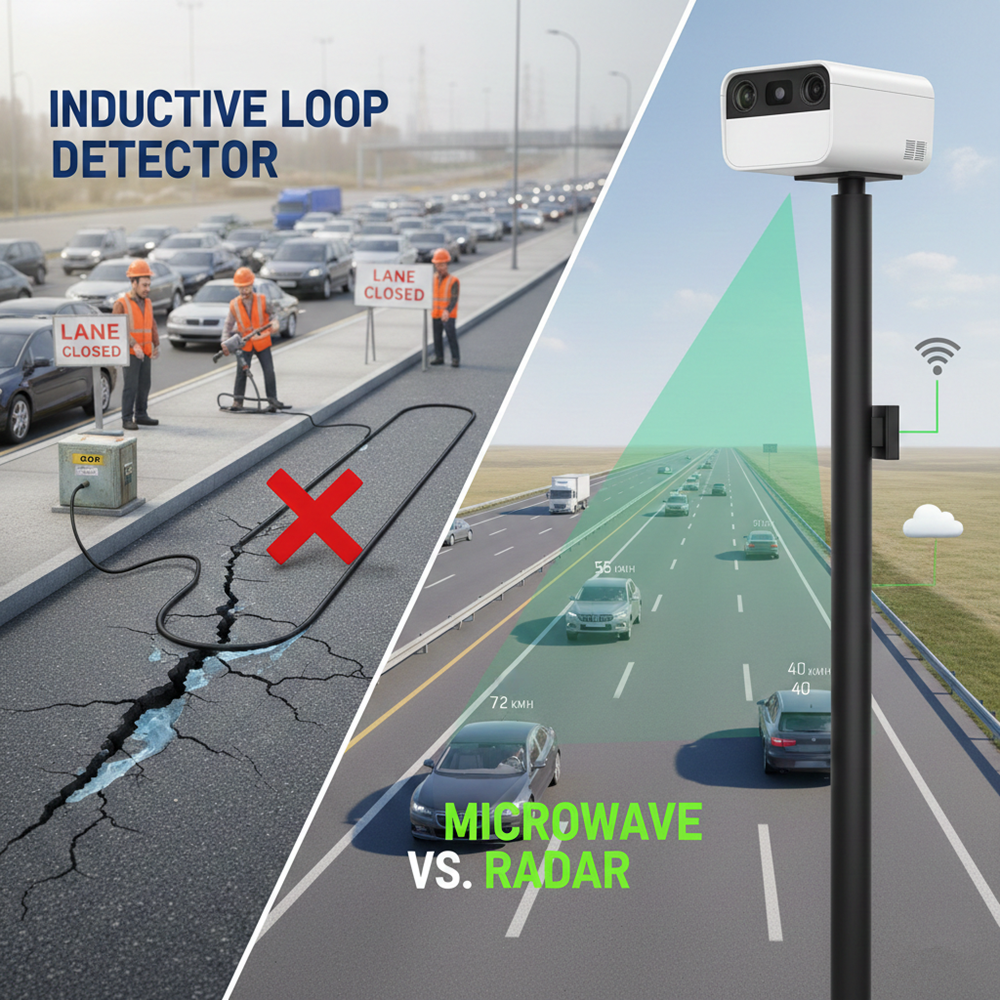
Intrusive Installation: Requires cutting into the asphalt, which weakens the road.
-
High Failure Rates: Road shifting, potholes, and utility work frequently break the wires.
-
Traffic Disruption: Installing or fixing a loop requires closing lanes.
2. What is Traffic Radar?
Traffic radar (specifically FMCW – Frequency Modulated Continuous Wave) uses microwave sensors mounted on poles to “scan” the road. It measures the Doppler shift or time-of-flight of the waves bouncing off vehicles to determine presence, speed, and volume.
Pros:
-
Non-Intrusive: No road cutting required. Installation happens on existing poles (above-ground).
-
Multi-Lane Coverage: A single radar unit can often track up to 8 or 10 lanes simultaneously.
-
Rich Data: Beyond simple detection, radar provides speed, vehicle classification (truck vs. car), and gap distance.
Cons:
-
Line-of-Sight Limitations: Large trucks can “occlude” or hide smaller cars behind them.
-
Weather Sensitivity: While modern radar is robust, extreme heavy rain or “clutter” can occasionally cause noise in the data.
3. Head-to-Head Comparison: The Key Metrics
| Feature | Inductive Loop Detector | Microwave Radar |
| Installation | Invasive (Road Cutting) | Non-Invasive (Pole Mounted) |
| Maintenance | High (Susceptible to road wear) | Low (Long lifespan) |
| Data Types | Presence & Basic Count | Speed, Class, Count, & Presence |
| Cost (per lane) | Low (Initial) / High (Lifetime) | High (Initial) / Low (Lifetime) |
| Lifespan | 2–5 years (depending on road) | 10+ years |
4. Deep Dive: Accuracy and Reliability
When it comes to simple presence detection (knowing a car is at the white line), loops are hard to beat. They provide a binary “Yes/No” with near 100% accuracy if the loop is intact.
However, Radar has caught up. Advanced 4D radar systems now use multi-beam technology to “see” around obstacles. Where radar truly wins is in advanced detection. Because radar can see several hundred feet back, it can calculate “Dilemma Zones”—the point where a driver has to decide whether to stop or go when a light turns yellow. Loops can only tell you a car is there; Radar tells you how fast it’s coming.
5. Cost Analysis: The “Iceberg” Effect
Many agencies choose loops because the upfront hardware cost is significantly lower. However, this is often a “false economy.”
-
The Hidden Costs of Loops: You must factor in the cost of a saw-cutting crew, traffic control (coning off lanes), and the inevitable replacement every time the road is repaved or a water main breaks.
-
The Value of Radar: While a high-end radar unit might cost five times more than a roll of loop wire, it covers four lanes at once. When you calculate the Total Cost of Ownership (TCO) over 10 years, radar typically saves municipalities 30% to 50% in maintenance labor.
6. Environmental and Structural Impact
We cannot ignore the structural integrity of our roads. Every time you cut a “V” into the pavement for a loop, you create a point of entry for water. In colder climates, this leads to freeze-thaw cycles that accelerate the creation of potholes.
Radar is the “green” choice here. By keeping the pavement intact, the road surface lasts longer, and because radar can be configured remotely via software, you don’t need to send a diesel truck and a 4-man crew to the middle of the intersection just to change a setting.
7. Which Should You Choose?
Choose Inductive Loops if:
-
You are working in a remote area with zero existing pole infrastructure.
-
The budget is strictly limited to immediate “first-cost” capital.
-
You only need simple “trigger” detection for a low-traffic private gate.
Choose Radar if:
-
You are building a Smart City or adaptive traffic signal system.
-
The road experiences heavy truck traffic or extreme temperature swings.
-
You want to collect “Big Data” (speed trends, congestion metrics) for urban planning.
-
Worker safety is a priority (minimizing time spent in live traffic lanes).