Radar-Video Fusion Technology: The Future of All-Weather Traffic Monitoring
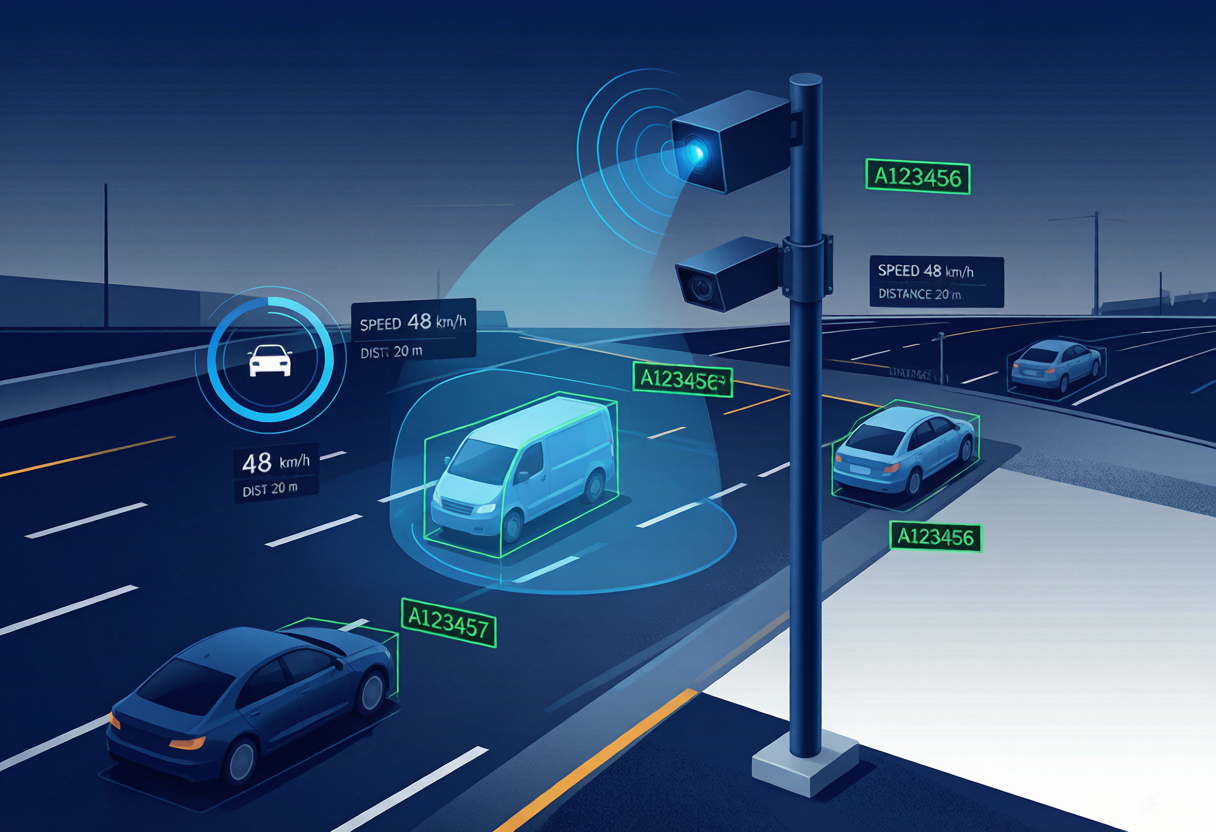
Traffic monitoring systems are the silent sentinels of our roads, ensuring safety and efficiency across our transportation networks. But they face a fundamental challenge: no single sensing technology is perfect. Cameras provide rich visual detail—license plates, vehicle colors, lane markings—but they blind in fog, heavy rain, snow, and darkness. Radar sensors deliver precise speed and distance data in any weather, but they cannot “see” visual details. Radar-video fusion technology bridges this gap by combining the strengths of both sensors into a single, intelligent traffic monitoring system.
In this guide, we’ll explore how radar-video fusion works, why it’s becoming the standard for smart city ITS deployments, and what you need to know before implementing it in your traffic management project.
The Problem: Why Single-Sensor Systems Fall Short
According to the U.S. Federal Highway Administration, adverse weather conditions are a factor in nearly 21% of annual vehicle crashes. This statistic underscores a critical weakness in camera-only traffic monitoring systems: when visibility drops, so does their effectiveness.
| Challenge | Camera-Only Systems | Radar-Only Systems |
|---|---|---|
| Fog & Heavy Rain | Severely degraded or blind | Unaffected |
| Night / Low Light | Requires IR illumination; limited range | Full performance |
| Speed Measurement | Indirect (frame-by-frame estimation); lower accuracy | Direct (Doppler/FMCW); high accuracy |
| License Plate Recognition | Excellent (when visible) | Not possible |
| Vehicle Classification | Good (visual AI) | Limited (size-based only) |
| Multi-Lane Coverage | Limited by camera FOV and resolution | Excellent (multi-target tracking) |
| Legal Evidence Quality | Visual evidence (strong) | Numeric data only (weak alone) |
The table makes the case clear: each technology has complementary strengths and weaknesses. This is where fusion technology creates a system that is more capable than the sum of its parts.
How Radar-Video Fusion Works
Radar-video fusion is not simply mounting a camera next to a radar sensor and displaying both outputs side by side. True fusion involves AI-based algorithms that merge data from two different coordinate systems at the data or feature level, creating a unified, enriched dataset that leverages the strengths of both modalities.
The Fusion Pipeline
A modern radar-video fusion system processes data through several stages:
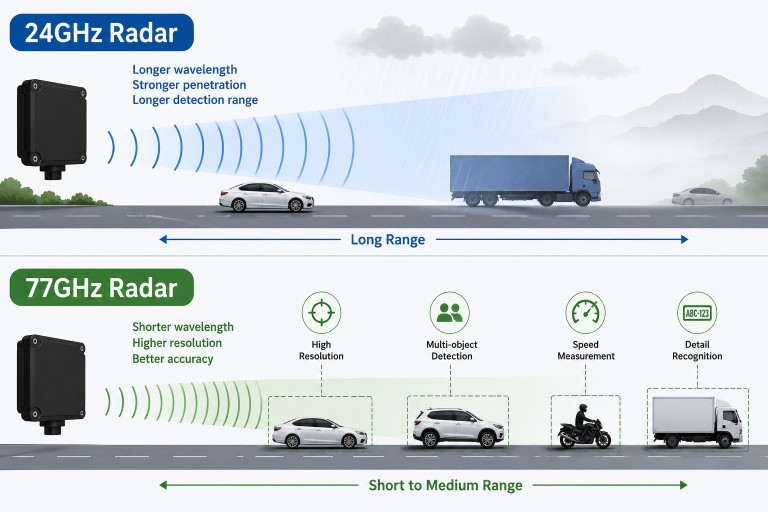
- Radar Detection: The millimeter-wave radar sensor (typically 24GHz or 77GHz) emits microwave signals and receives reflections from vehicles. Using FMCW (Frequency Modulated Continuous Wave) technology, it calculates each target’s distance, speed, and angle—tracking multiple vehicles simultaneously across multiple lanes. (See our HC-M150 multi-target traffic radar for a real-world implementation.)
- Video Capture: A high-definition camera (often 5+ megapixels) captures visual data of the same scene. AI-based image processing identifies vehicles, reads license plates, classifies vehicle types, and detects lane positions.
- Coordinate Alignment: The fusion algorithm maps the radar’s range-Doppler coordinate system to the camera’s pixel coordinate system. This calibration step—increasingly automated by AI—aligns the two data streams so that a radar-detected target corresponds to the correct visual object.
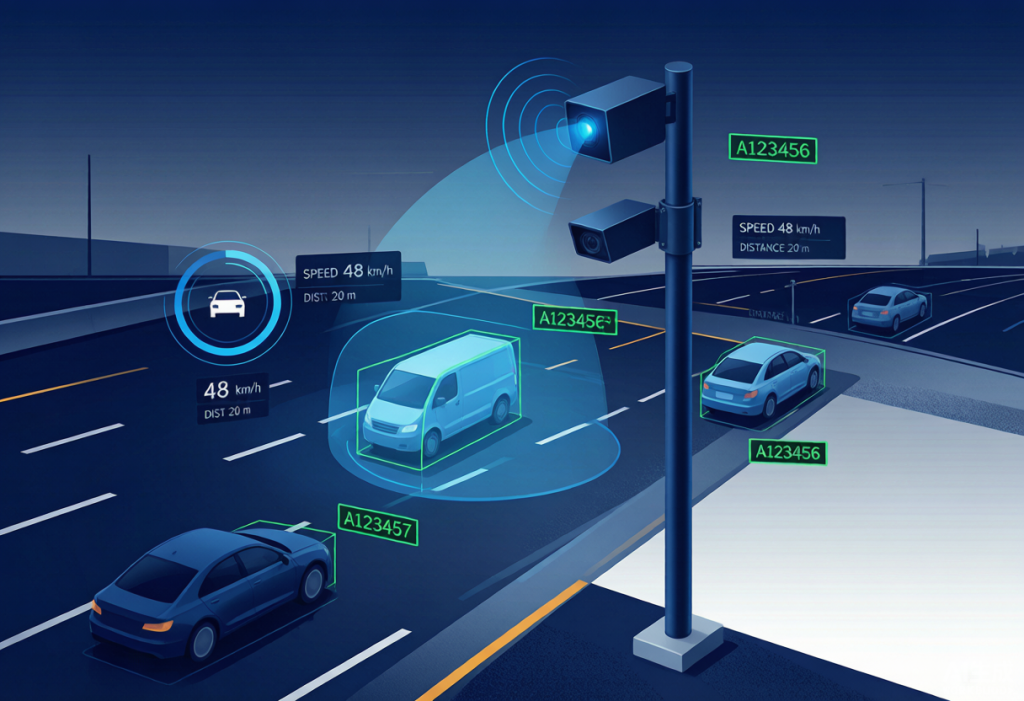
- Data Fusion: The AI merges the datasets: the radar contributes precise speed, distance, and tracking data; the camera contributes visual identification, classification, and plate recognition. The fused output is richer and more reliable than either source alone.
- Decision & Output: The system outputs a comprehensive dataset—vehicle position, speed, classification, license plate, lane assignment, and violation status—that feeds directly into traffic management platforms, enforcement systems, or digital twin models.
Key Benefits of Radar-Video Fusion
1. True All-Weather, All-Light Performance
When fog blankets a highway at 2 AM, a camera-only system is effectively blind. A radar-only system can still detect vehicles and measure speed, but it cannot identify a specific violator or capture visual evidence. A fusion system delivers both: radar tracks the speeding vehicle through the fog, and the camera—supplemented by infrared illumination—captures the license plate for enforcement. This creates a fail-safe system where the weaknesses of one sensor are covered by the strengths of the other.
2. Complete Evidence Chains for Enforcement
For speed enforcement, legal evidence typically requires both a speed measurement and visual identification of the vehicle. Radar provides the speed measurement with high accuracy; the camera provides the visual proof (license plate, vehicle type, lane position). Fusion systems automatically overlay speed data, time stamps, and license plate images onto a single evidence record—creating an airtight chain that holds up in court.
3. Enhanced Detection Accuracy
By cross-referencing two independent sensor modalities, fusion systems reduce false positives and false negatives. If the radar detects a target that the camera doesn’t see (possible noise or reflection), the system can flag it for review. If the camera sees a vehicle that the radar doesn’t (possible sensor occlusion), the system can use video-based speed estimation as a fallback. This redundancy significantly improves reliability.
4. Richer Data for Smart City Applications
Fusion systems deliver a comprehensive data stream: vehicle count, classification, speed, occupancy, queue length, lane assignment, and individual vehicle identification. This rich dataset enables advanced smart city applications:
- Adaptive signal control: Real-time vehicle density data from fusion sensors enables traffic signals to dynamically adjust timing, reducing congestion by up to 18% and delays by 25% in pilot deployments.
- Incident detection: Radar can detect stopped vehicles, wrong-way drivers, and pedestrians in real-time, triggering immediate alerts and automated camera focus for visual verification.
- Digital twin modeling: The comprehensive data stream feeds 3D digital twin models of intersections, enabling traffic planners to simulate and optimize road configurations virtually.
- Traffic analytics: Long-term data collection enables trend analysis, congestion pattern identification, and data-driven infrastructure planning.
5. Simplified Installation and Maintenance
Modern fusion systems integrate radar and camera into a single housing, requiring only one mounting point, one power connection, and one network connection. AI-driven automatic calibration has reduced setup time from 30 minutes to under 5 minutes in the latest generation. This integrated approach also simplifies maintenance—fewer devices to monitor, fewer failure points, and a single service interface.
Real-World Applications
Speed Enforcement
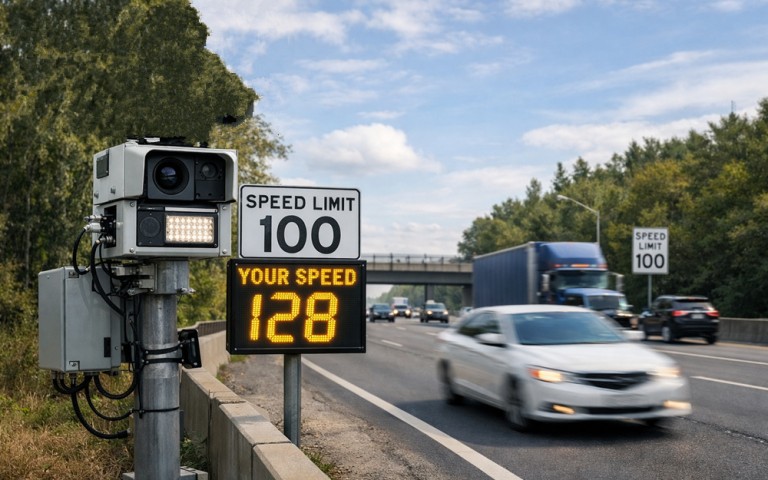
The most common application of radar-video fusion is automated speed enforcement. The traffic radar measures vehicle speed with high precision (typically ±1 km/h or better), and the camera captures the license plate. The system can monitor multiple lanes simultaneously—modern systems cover up to 8 lanes in both directions—generating complete, legally defensible evidence for each violation.
Intersection Management
At signalized intersections, fusion sensors provide comprehensive data for adaptive signal control. The radar tracks vehicle approach speeds and queue lengths; the camera identifies vehicle types (allowing prioritization of public transport or emergency vehicles) and detects red-light violations. Combined, this data enables real-time signal optimization that reduces wait times and improves throughput.
Highway Monitoring
On highways, fusion systems monitor traffic flow, detect incidents (stopped vehicles, wrong-way drivers, debris), and generate enforcement evidence. The radar’s long-range detection (up to 300+ meters) provides early warning of approaching vehicles or incidents, while the camera provides the visual context needed for operator decision-making and automated response.
Pedestrian and VRU Protection
At crosswalks and school zones, fusion systems detect pedestrians and vulnerable road users (VRUs) with high reliability. The radar detects the presence and movement of a person (regardless of lighting conditions), and the camera confirms the classification. When a VRU is detected in a conflict zone, the system can trigger warning systems—flashing beacons, audible alerts, or even direct communication to connected vehicles.
Radar-Video Fusion vs. Alternatives
| Feature | Camera-Only AI | Radar-Only | Radar-Video Fusion |
|---|---|---|---|
| Weather Reliability | Poor (fog, rain, snow) | Excellent | Excellent |
| Speed Accuracy | Moderate (±3-5 km/h) | High (±1 km/h) | Very High (±1 km/h, cross-verified) |
| Visual Evidence | Yes | No | Yes |
| Vehicle Classification | Good | Limited | Excellent |
| Multi-Lane Coverage | Limited by resolution | Up to 8 lanes | Up to 8 lanes |
| Installation Complexity | Moderate | Simple | Moderate (integrated units) |
| Relative Cost | Low | Medium | Higher (but value justifies) |
Frequently Asked Questions
- Is radar-video fusion technology new?
- While the concept has existed for several years, it has only become practical for widespread deployment recently due to three advances: (1) affordable millimeter-wave radar chips, (2) powerful edge AI processors that can run fusion algorithms in real-time, and (3) automated calibration algorithms that reduce setup time. The technology is now mature and deployable at scale.
- Can radar-video fusion replace inductive loops entirely?
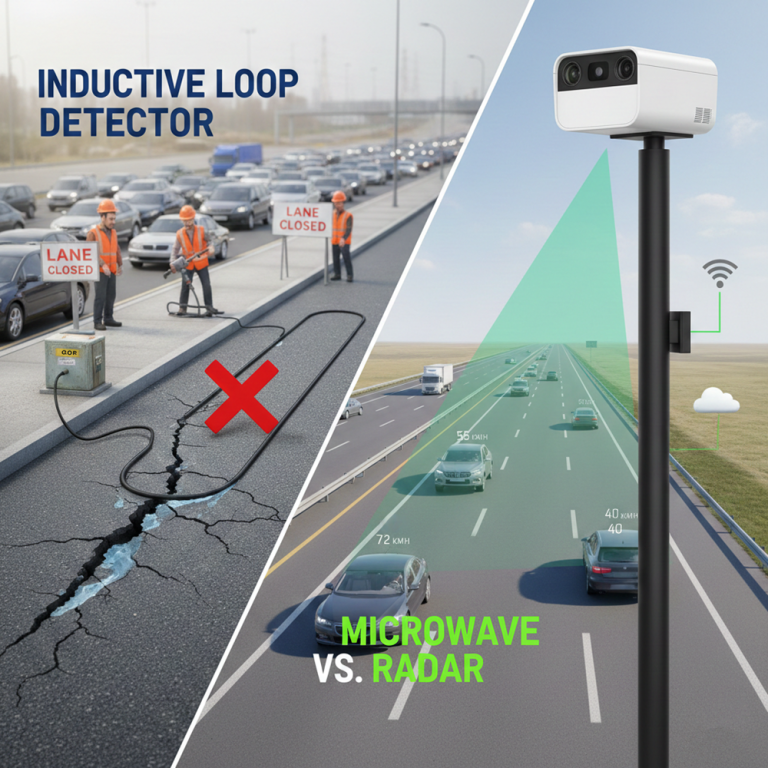
- In most new deployments, yes. Fusion sensors provide all the detection capabilities of inductive loops (presence, count, speed, classification) plus visual evidence, multi-lane coverage, and all-weather reliability—without the invasive roadwork installation and maintenance that loops require. However, some existing installations may retain loops for redundancy or specific trigger applications.
- How accurate is speed measurement in a fusion system?
- Modern fusion systems achieve speed measurement accuracy of ±1 km/h or better, verified by cross-referencing radar Doppler data with camera-based trajectory analysis. The latest generation using feature-level fusion and sliding-window algorithms has pushed accuracy from 98% to 99.9%, making the evidence suitable for legal speed enforcement.
- What’s the detection range of a typical radar-video fusion system?
- Depending on the radar frequency and configuration, detection ranges typically span 50 to 300+ meters. 24GHz systems offer wider coverage but shorter effective range for fine detail, while 77GHz systems can detect vehicles at greater distances with finer resolution. The camera’s effective range depends on resolution and lens configuration but typically matches or exceeds the radar’s detection range.
- How much does a radar-video fusion system cost compared to separate components?
- Integrated fusion sensors carry a higher upfront cost than standalone cameras or radars. However, when you factor in the cost of separate mounting hardware, additional installation labor, separate network connections, and the software integration required to combine separate sensor outputs, integrated fusion systems are often cost-competitive—and they deliver significantly better performance and reliability.
- Does radar-video fusion work with existing traffic management software?
- Yes. Most modern fusion sensors support standard ITS communication protocols and provide SDK/API access for integration with existing traffic management platforms. Data outputs typically include standardized formats for vehicle detection, speed measurement, and violation evidence, making integration with TMS (Traffic Management Systems), enforcement back-office systems, and ANPR platforms straightforward.
Conclusion: The Future is Fused
Radar-video fusion technology represents the natural evolution of traffic monitoring—moving from single-sensor limitations to integrated, intelligent systems that deliver comprehensive, reliable, all-weather performance. For smart cities, highway agencies, and traffic enforcement organizations, fusion systems provide the data quality and evidentiary strength needed for modern traffic management.
The technology is no longer experimental. It’s being deployed at scale across global ITS projects, from adaptive intersection control in urban centers to highway speed enforcement networks spanning hundreds of kilometers. As AI processing power continues to increase and component costs decline, radar-video fusion will become the standard—not the exception—for new traffic monitoring installations.
If you’re planning a traffic monitoring or enforcement project, consider how fusion technology could enhance your detection capabilities. Explore our traffic radar solutions to learn how multi-target radar sensors form the foundation of modern fusion systems, check out the HC-M150 multi-target radar for detailed specifications, or contact our team to discuss your specific deployment requirements.