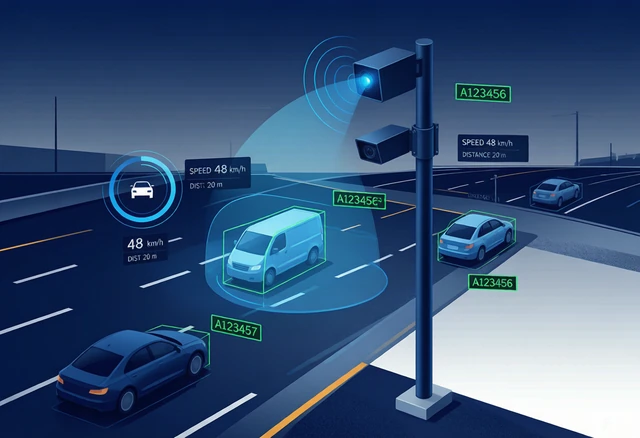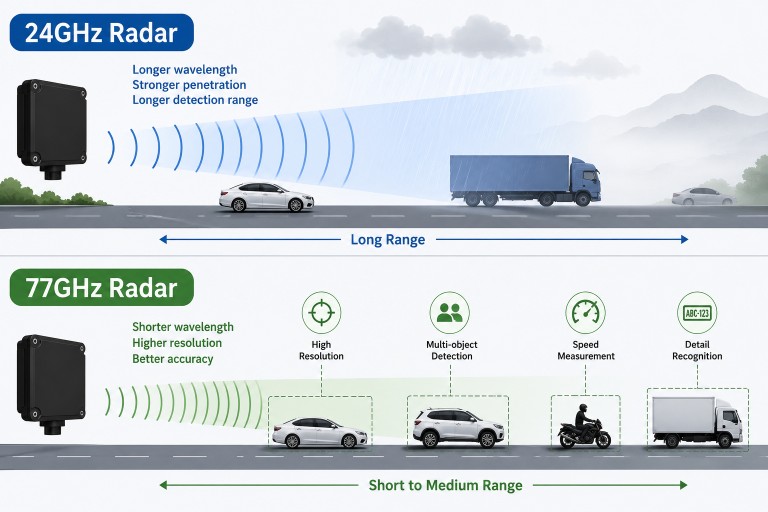
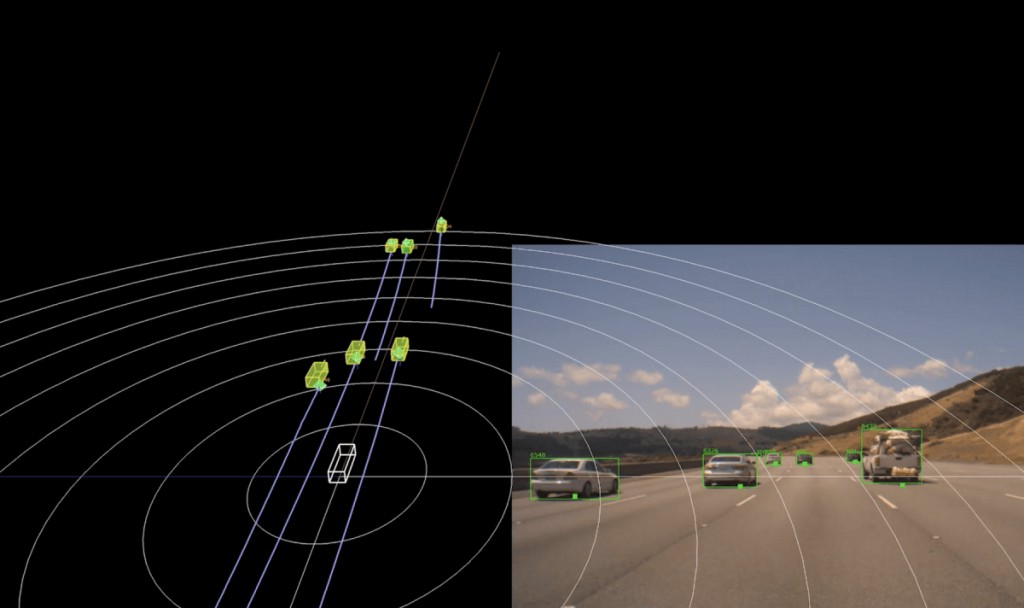
A radar sensor does not automatically see a vehicle, person or other object in the same way that a human interprets a scene. At the measurement level, it receives reflected electromagnetic energy and estimates parameters such as range, radial velocity and angle.
Radar object tracking is the processing stage that converts these measurements into stable target tracks. A track can contain an object ID, position, speed, direction, lane assignment and a history of how the object has moved over time.
This continuous information is valuable in traffic monitoring, speed measurement, perimeter protection, industrial automation and sensor-fusion systems. However, reliable tracking requires more than connecting consecutive detection points. The system must distinguish real targets from clutter, associate new measurements with existing tracks and manage objects that enter, cross or leave the radar field of view.
Radar Detection and Radar Tracking Are Different
Detection answers a relatively short-term question:
Is there a radar return at this range, speed and angle?
Tracking answers a more complex question:
Does this measurement belong to an object that was detected previously, and what is that object likely to do next?
A single physical object may produce one detection or several detection points. At the same time, noise, multipath reflections and roadside structures may generate measurements that do not represent real objects.
The tracker must determine which measurements belong together and whether they correspond to a new object, an existing object or clutter.
A typical tracked-object output may include:
- Unique object ID
- Longitudinal and lateral position
- Absolute or relative speed
- Heading or direction of travel
- Acceleration estimate
- Lane assignment
- Object length or classification
- Track confidence
- Time since the last valid update
Not every radar outputs all these parameters. Available information depends on the antenna, waveform, signal processing, tracking software and communication interface.
The Radar Object-Tracking Pipeline
A practical tracking system normally contains several processing stages.
1. Measurement Generation
The radar transmits a waveform and receives reflections from objects in the detection area. Signal processing estimates parameters such as:
- Range
- Radial velocity
- Azimuth angle
- Elevation angle, when supported
- Signal strength or confidence
These measurements are often called detections, points or targets. They are not yet stable object tracks.
Measurement quality depends on factors including bandwidth, antenna aperture, signal-to-noise ratio, target reflectivity and interference from the surrounding environment.
2. Detection Filtering and Clustering
A high-resolution radar may produce multiple detection points from one vehicle. Reflections can come from the front, side, wheels or other parts of the same object.
Clustering algorithms group related detections before track creation. The grouping may consider:
- Distance between points
- Similarity of radial velocity
- Angular separation
- Expected object size
- Measurement history
- Lane or region boundaries
If clustering is too aggressive, two nearby vehicles may be merged into one object. If it is too restrictive, one large vehicle may be divided into several tracks.
The correct parameters therefore depend on the application and the expected target types.
3. State Prediction
Before processing the next radar update, the tracker predicts where each existing object is likely to appear.
Prediction uses the previous estimated state and a motion model. For a road vehicle travelling at a stable speed, the system may predict its next position from its current position, velocity and the time between radar updates.
Prediction is important because measurements are noisy. It also allows a track to survive briefly when a detection is missed or temporarily blocked.
The predicted position is not treated as exact. It is normally accompanied by an uncertainty region that grows when the object has not been measured recently or when its motion becomes less predictable.
4. Measurement Gating
Gating eliminates measurements that are too far from the predicted state to be reasonable candidates for an existing track.
For example, if a vehicle was travelling in the right lane at 70 km/h, a detection appearing on the opposite side of the road in the next update is unlikely to belong to that vehicle.
A gate may consider:
- Position difference
- Speed difference
- Direction difference
- Statistical distance
- Maximum possible acceleration
- Lane boundaries
A narrow gate reduces false associations but may lose a rapidly manoeuvring object. A wide gate accommodates greater motion uncertainty but creates more competing association candidates.
5. Data Association
After gating, the tracker decides which measurement belongs to which track. This is one of the most difficult parts of multi-object tracking.
When vehicles are well separated, association is relatively straightforward. It becomes more difficult when:
- Two vehicles travel close together
- Vehicles overtake or cross paths
- A large vehicle blocks a smaller one
- Several detections have similar speed and position
- Multipath produces ghost detections
- A target temporarily disappears
- New objects enter a crowded detection area
Incorrect association can cause an ID switch, track jump, merged track or duplicated track.
6. State Estimation and Filtering
After a measurement is associated with a track, the tracker combines the predicted state with the new observation.
The purpose of filtering is not simply to smooth the output. It estimates the most likely target state while accounting for uncertainty in both the motion model and radar measurements.
The updated track is then used as the starting point for the next prediction cycle.
7. Track Management
The tracker must decide when to create, confirm, maintain and delete tracks.
A common track lifecycle includes:
- Tentative track
- Confirmed track
- Coasting track
- Deleted track
A tentative track may require several consistent detections before it becomes confirmed. This prevents isolated noise points from immediately appearing as real objects.
When a confirmed object is temporarily missed, its track may enter a coasting state. The system continues predicting the object for a limited number of updates. If valid measurements return, the track can be recovered. If not, it is eventually deleted.
Motion Models Used in Radar Tracking
The motion model describes how the tracker expects an object to move between updates.
Constant-Velocity Model
The constant-velocity model assumes that the target maintains approximately the same speed and direction during the next short interval.
It is computationally efficient and suitable for many road-monitoring situations. However, its prediction error increases when a vehicle brakes, accelerates or turns sharply.
Constant-Acceleration Model
This model adds acceleration to the estimated target state. It can better represent vehicles that are speeding up or slowing down.
It also requires more reliable measurements because estimating additional state variables increases uncertainty.
Coordinated-Turn Model
A coordinated-turn model represents objects following a curved path with an approximately consistent turn rate.
It can improve tracking at intersections, ramps and curved roads where a straight-line motion model is insufficient.
Interacting Multiple Model
An interacting multiple model tracker runs several motion models and adjusts their probabilities according to observed target behaviour.
For example, a vehicle may initially use a constant-velocity model and then give greater weight to a turning model as it enters an intersection.
This improves adaptability but requires more processing and careful parameter selection.
Common Data-Association Methods
Different tracking systems use different association strategies depending on object density, processing resources and required reliability.
Nearest-Neighbour Association
Nearest-neighbour association assigns the most suitable nearby measurement to a predicted track.
Its advantages are simplicity and low processing demand. It works well when targets are clearly separated, but it can make incorrect assignments in dense or crossing traffic.
Global Assignment
A global assignment method evaluates multiple track-to-measurement combinations together rather than making each decision independently.
This can produce more consistent results in multi-object scenes. The Hungarian algorithm is one method commonly used to solve assignment problems after a cost matrix has been created.
Probabilistic Data Association
Probabilistic data association considers several possible measurements and weights them according to their likelihood of belonging to a track.
It can be more robust in cluttered environments, although its assumptions and computational demands must be considered.
Multiple-Hypothesis Tracking
Multiple-hypothesis tracking retains several possible association histories until later measurements provide enough information to select the most likely explanation.
It can handle ambiguous scenes effectively, but the number of hypotheses can grow rapidly without pruning and track-management rules.
Kalman and Nonlinear Filters
Filtering methods are selected according to the motion model, radar measurement model and available processing capacity.
Kalman Filter
The Kalman filter provides efficient recursive state estimation for linear systems with Gaussian noise assumptions.
It alternates between prediction and measurement update. For appropriate applications it offers a practical balance between accuracy and processing demand.
Extended Kalman Filter
Radar measurements are often expressed in polar coordinates while target tracks are maintained in Cartesian coordinates. This can create nonlinear relationships.
The extended Kalman filter handles nonlinear functions through local linearisation. Its performance can degrade when the system is strongly nonlinear or the initial estimate is poor.
Unscented Kalman Filter
The unscented Kalman filter uses selected sample points to propagate the state distribution through nonlinear functions.
It can estimate nonlinear systems without explicitly calculating the same Jacobian matrices required by an extended Kalman filter, although it generally needs more computation.
Particle Filter
A particle filter represents the state distribution using many weighted samples. It can model nonlinear and non-Gaussian conditions but may require substantial processing power.
For many embedded roadside radar systems, the final algorithm is selected according to the required update rate and target capacity rather than theoretical accuracy alone.
Why Radar Tracks Can Become Unstable
Even a radar with good range and speed resolution can produce unstable tracks if the installation or tracking configuration is unsuitable.
Common causes include:
Occlusion
A large truck may block a smaller vehicle behind it. The tracker must decide whether to preserve the hidden track or delete it.
Multipath Reflections
Radar energy can reflect from barriers, signs, buildings and vehicles before returning to the sensor. This may produce detections at incorrect apparent positions.
Closely Spaced Targets
Vehicles travelling side by side or in a queue can be difficult to separate when angular or range resolution is insufficient.
Rapid Manoeuvres
Sudden braking, lane changes and turns may place the true measurement outside the predicted gate.
Sensor Misalignment
Incorrect yaw, pitch, mounting height or road-coordinate configuration can affect lane assignment and position output.
Improper Track Parameters
Track confirmation that is too fast may create false tracks. Deletion that is too aggressive may break trajectories during brief missed detections.
Point Targets and Extended Objects
A traditional point-target model assumes that each physical object generates one representative measurement.
High-resolution radar may instead receive several detections from one vehicle or person. This is known as an extended-object tracking problem.
Extended-object processing can use the distribution of detections to estimate:
- Object dimensions
- Orientation
- Vehicle outline
- Classification features
- More accurate object centre
However, it also makes clustering and data association more complex. The system must determine whether nearby points belong to one large object or several smaller targets.
Radar Object Tracking in Traffic Systems
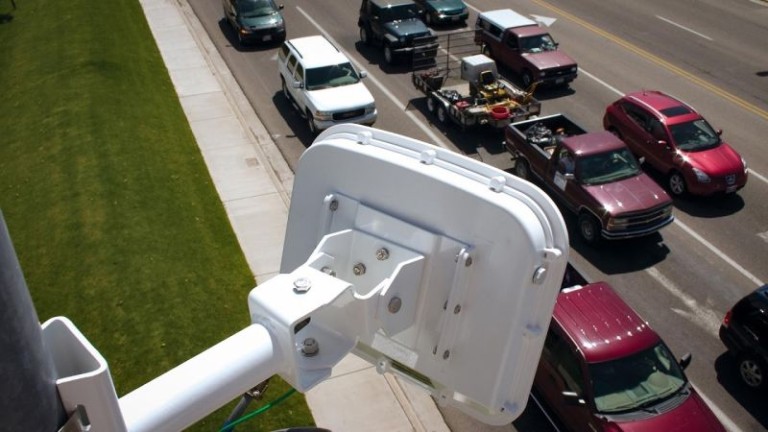
Roadside tracking radar can provide more than a vehicle count at a virtual line.
A continuous target list can support:
- Per-lane traffic flow monitoring
- Speed and headway measurement
- Queue-length estimation
- Lane-change analysis
- Wrong-way vehicle detection
- Stopped-vehicle detection
- Turning-movement statistics
- Camera triggering
- Signal-control input
- Incident-detection logic
- Radar and video fusion
For traffic-flow monitoring, tracked targets can be converted into lane-based statistics such as volume, average speed, occupancy and headway.
For camera integration, position and trajectory information can help associate a vehicle with a virtual measurement line or image trigger. The complete system still requires coordinate calibration, time synchronisation and consistent target identifiers.
Read more about this architecture in our traffic flow monitoring radar solution.
How to Evaluate Tracking Performance
Maximum detection distance alone does not describe tracking quality.
A practical evaluation should consider:
- Position error
- Speed error
- Track continuity
- Track-confirmation time
- Missed-track rate
- False-track rate
- ID switches
- Track fragmentation
- Target separation
- Update latency
- Output stability during congestion
- Recovery after temporary occlusion
Testing should include realistic traffic densities, vehicle sizes and road geometry. A test conducted with one isolated vehicle may not reveal problems that appear when several targets overlap.
HC-M250 Target-Level Traffic Data
The HC-M250 long-range traffic radar is designed for roadside traffic monitoring and system integration.
It combines target-level detection with lane-based traffic-flow statistics. The current product configuration supports a monitoring distance of up to 300 metres, coverage of up to eight lanes, tracking of up to 128 targets and a 70 ms update cycle.
Target output can provide information used by traffic-management platforms, controllers and related data systems. Actual performance depends on road geometry, mounting position, target visibility and integration settings.
HC-M250 is positioned for traffic monitoring and control applications. It should not automatically be treated as a legally certified speed-enforcement instrument.
Frequently Asked Questions
What is radar object tracking?
Radar object tracking is the process of connecting radar measurements over time to estimate the continuous position, speed, direction and identity of moving objects.
What is the difference between a detection and a track?
A detection is a measurement from one radar update. A track combines measurements from multiple updates and includes a predicted and filtered target state.
Why is data association important?
Data association determines which new measurement belongs to which existing track. Incorrect association can cause ID switches, merged tracks or broken trajectories.
Why is a Kalman filter used in radar tracking?
A Kalman filter combines motion prediction with noisy measurements to estimate an object’s state recursively. It is efficient for systems that fit its modelling assumptions.
Can radar track several vehicles at the same time?
Yes. Multi-object radar can maintain multiple tracks, but the supported target capacity and separation performance depend on the hardware, processing algorithms and scene complexity.
Can tracking continue when a vehicle is temporarily hidden?
A tracker can predict the target state for a limited time during missed detections. Whether the same track is recovered depends on the occlusion duration and association logic.
Does a higher update rate always produce better tracking?
A faster update rate can improve response to changing motion, but measurement quality, latency, resolution and algorithm design are also important. Update rate should not be assessed alone.
Conclusion
Radar object tracking is a complete processing chain rather than a single filtering algorithm.
The tracker must transform radar measurements into candidate objects, predict their motion, associate new observations, estimate their states and manage each track throughout its lifecycle. Reliable performance depends on the interaction of all these stages.
For traffic and security applications, the most useful evaluation is not simply whether the radar detects an object. It is whether the system maintains the correct identity, position, speed and trajectory when several targets move through a realistic operating environment.