24GHz vs 77GHz Traffic Radar: Choosing the Right Frequency for Your ITS Project
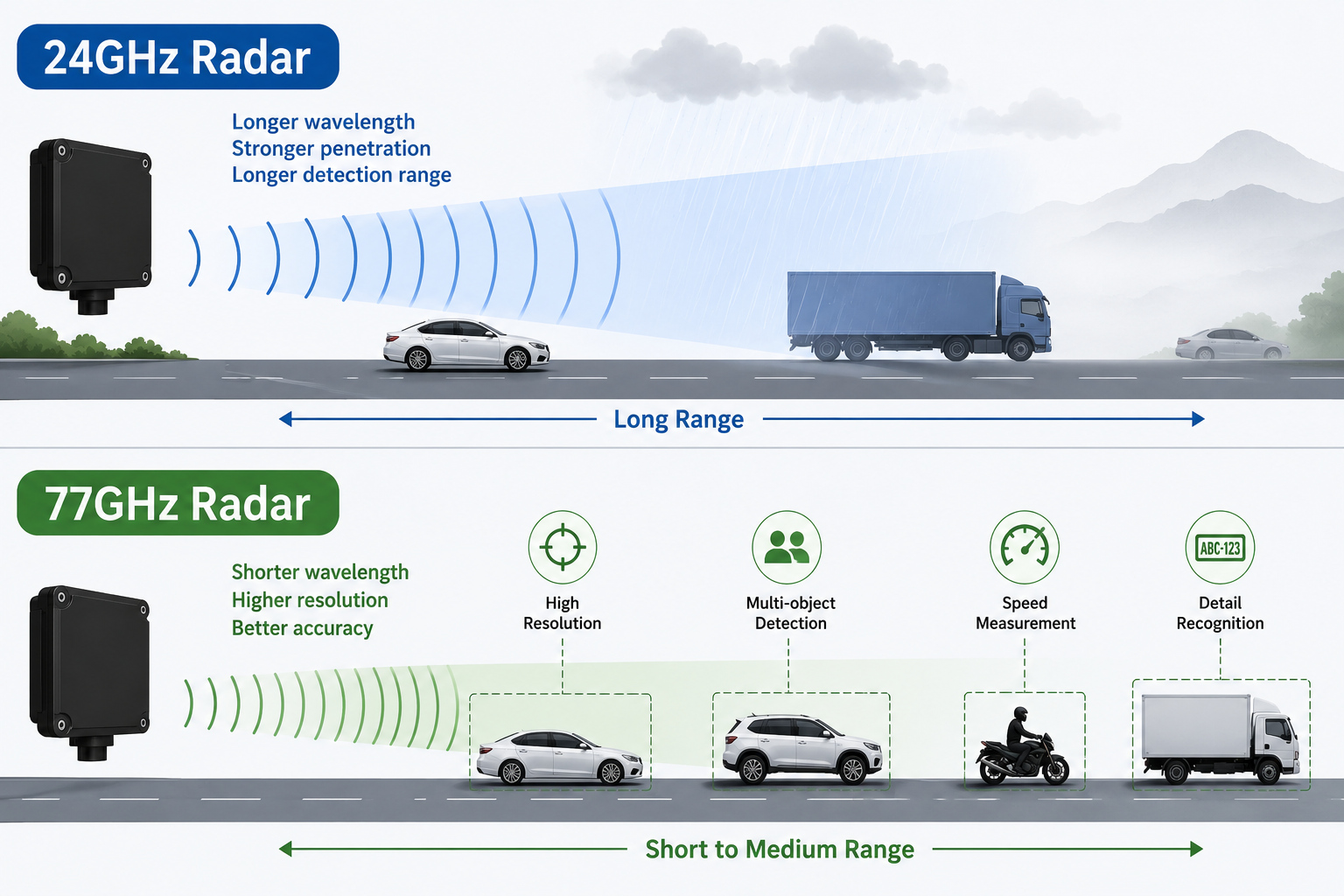
When you’re specifying radar sensors for an Intelligent Transportation System (ITS) project, one of the first decisions you’ll face is frequency: 24GHz or 77GHz? Both are widely used in traffic radar applications, from speed enforcement to intersection management to highway monitoring. But they are not interchangeable. Each frequency band offers distinct trade-offs in range resolution, accuracy, antenna size, regulatory availability, and cost.
This guide breaks down the technical differences between 24GHz and 77GHz traffic radar sensors so you can make an informed choice for your deployment—whether you’re building a smart city traffic management system, a highway speed enforcement network, or an adaptive signal control installation.
What is a 24GHz Traffic Radar?
The 24GHz band has been the workhorse of traffic radar for over a decade. It operates in the 24.05–24.25 GHz range (narrowband ISM band, 250 MHz bandwidth) and, historically, also in a wider 5 GHz ultrawideband (UWB) segment. The technology uses microwave signals that bounce off vehicles and return to the sensor, allowing it to calculate speed, distance, direction, and even vehicle classification.
24GHz radars earned their place in traffic management because they offer reliable vehicle detection, good weather resistance (rain, fog, and dust don’t significantly affect performance), and real-time data processing. They are particularly well-suited for wide coverage scenarios—intersection management, multi-lane highway monitoring, and traffic flow data collection—where the ability to detect vehicles across a broad area matters more than ultra-fine resolution.
Key Advantages of 24GHz Traffic Radar
- Wide coverage area: Larger antenna beamwidth means a single sensor can cover multiple lanes simultaneously.
- Global regulatory availability: The 24GHz narrowband ISM band is authorized in most markets under harmonized Short Range Device (SRD) regulations, making it deployable worldwide.
- Cost-effective: Mature supply chain and established manufacturing keep hardware costs lower than 77GHz equivalents.
- Proven reliability: Decades of field deployment data confirm long-term stability in diverse environmental conditions.
What is a 77GHz Traffic Radar?
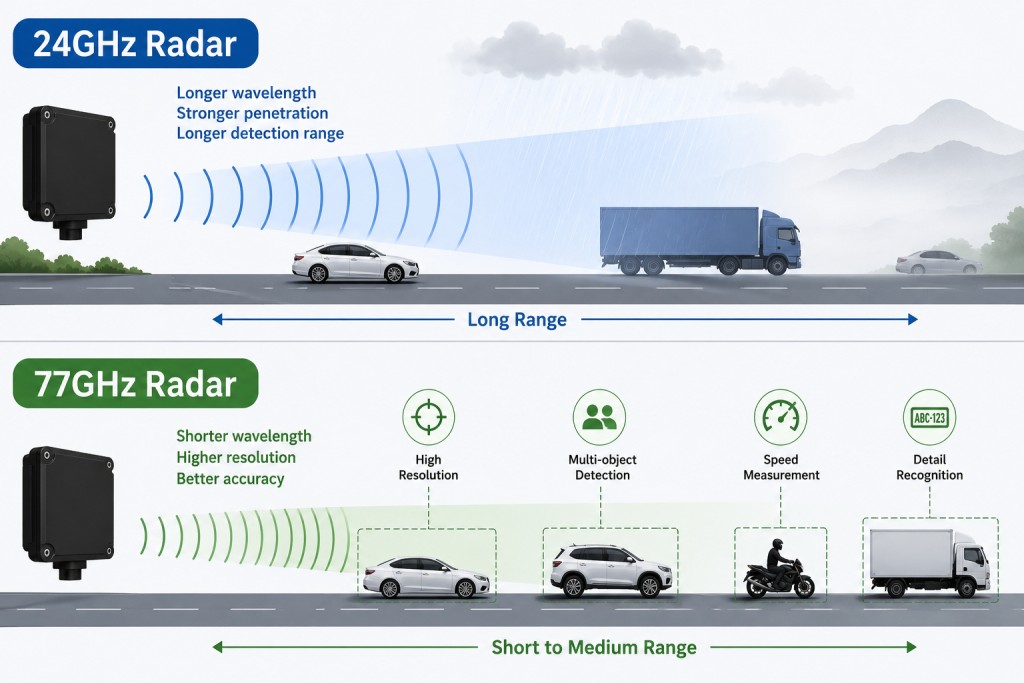
The 77GHz band represents the newer generation of traffic radar technology. It encompasses two sub-bands: the 76–77 GHz long-range radar (LRR) band and the 77–81 GHz short-range radar (SRR) band. The key differentiator is bandwidth—the 77GHz SRR band offers up to 4 GHz of sweep bandwidth, compared to the 250 MHz available at 24GHz narrowband.
This massive bandwidth advantage translates directly into performance. Range resolution improves by roughly 20x (from ~75 cm at 24GHz to ~4 cm at 77GHz), and velocity resolution improves by approximately 3x. The shorter wavelength (≈4 mm vs. ≈12 mm) also means antennas can be significantly smaller, enabling more compact sensor designs—a critical advantage for installations with space constraints or aesthetic requirements.
Key Advantages of 77GHz Traffic Radar
- Superior range resolution: 4 cm vs. 75 cm—the ability to distinguish between closely spaced objects, critical for detecting vehicles in adjacent lanes or separating a pedestrian from a nearby car.
- Higher velocity accuracy: 3x improvement in speed measurement precision, essential for speed enforcement applications where evidentiary accuracy is legally required.
- Compact form factor: Antenna area is roughly 1/9th the size of a comparable 24GHz antenna, enabling smaller, lighter, and more discreet sensor housings.
- Higher permitted transmit power: 77GHz LRR allows up to 55 dBm EIRP (vs. 20 dBm for 24GHz), enabling longer detection ranges for highway applications.
- Future-proof: Regulatory bodies in Europe (ETSI) and the US (FCC) have sunset the 24GHz UWB band, making 77GHz the long-term standard for new radar deployments.
24GHz vs 77GHz: Head-to-Head Comparison
| Parameter | 24GHz (Narrowband) | 77GHz |
|---|---|---|
| Frequency Range | 24.05–24.25 GHz | 76–81 GHz |
| Available Bandwidth | 250 MHz | Up to 4 GHz |
| Range Resolution | ~75 cm | ~4 cm |
| Velocity Resolution | Baseline | 3x better than 24GHz |
| Max Detection Range | Up to 300 m (wide beam) | Up to 300+ m (narrow beam, higher EIRP) |
| Antenna Size | Larger (λ ≈ 12 mm) | Compact (λ ≈ 4 mm, ~1/9 area) |
| Max EIRP | 20 dBm | 55 dBm (LRR band) |
| Weather Resistance | Excellent | Good (higher atmospheric attenuation) |
| Global Regulatory Status | Widely available (NB ISM) | Standardized, UWB 24GHz sunsetting |
| Typical Hardware Cost | Lower | Higher (but declining) |
| Best For | Wide-area detection, cost-sensitive projects | High-precision enforcement, compact installations |
Performance Deep Dive: Where the Differences Matter
Range Resolution and Object Separation
Range resolution is the radar’s ability to distinguish between two objects at similar distances. This is where the bandwidth difference is most impactful. A 24GHz narrowband radar with 250 MHz bandwidth achieves a range resolution of approximately 75 cm—meaning two vehicles closer than 75 cm apart will appear as a single target. A 77GHz radar with 4 GHz bandwidth achieves ~4 cm resolution, allowing it to separate a motorcycle from a car in an adjacent lane, or distinguish a pedestrian standing next to a vehicle.
For intersection management and stop-bar detection, this level of precision means fewer false triggers and more accurate queue length measurements. For highway monitoring, it means better lane assignment accuracy—knowing exactly which lane a vehicle is in, even in dense, multi-lane traffic.
Speed Measurement Accuracy
Velocity resolution and accuracy are inversely proportional to the carrier frequency. At 77GHz, the velocity resolution is approximately 3x better than at 24GHz. For general traffic monitoring (flow statistics, congestion detection), 24GHz accuracy is typically sufficient. But for speed enforcement applications—where measurement results may be used as legal evidence—the superior accuracy of 77GHz can be the difference between a citation that holds up in court and one that gets challenged.
Modern multi-target speed measurement radars, such as those in the HC-M150 series, leverage these high-accuracy measurements to simultaneously track and measure the speed of up to 64 targets across multiple lanes, with speed error controlled within ±1 km/h.
Detection Range and Coverage
Both frequencies can achieve detection ranges exceeding 300 meters, but the coverage patterns differ. 24GHz radars typically offer wider beamwidths, making them ideal for covering broad areas like large intersections. 77GHz radars can achieve longer effective ranges in a narrower beam—beneficial for highway speed enforcement where you need to detect vehicles far upstream.
One consideration: 77GHz signals experience higher atmospheric attenuation than 24GHz (roughly 9x more in some conditions). In practice, this is rarely a limiting factor for traffic radar deployments, as the detection distances (typically 100–300 m) are well within the effective range of both technologies, and the higher permitted EIRP at 77GHz compensates for the additional path loss.
Form Factor and Installation Flexibility
Antenna size scales inversely with frequency. The 77GHz wavelength (≈4 mm) is one-third of the 24GHz wavelength (≈12 mm), so a 77GHz antenna requires roughly one-ninth the area of an equivalent 24GHz antenna. This enables significantly more compact sensor designs—an important consideration for urban installations where aesthetics matter, or when retrofitting existing traffic light poles with limited mounting space.
Regulatory Landscape: The 24GHz UWB Sunset
An important factor in your frequency decision is the evolving regulatory landscape. In both Europe (under ETSI regulations) and the United States (under FCC rules), the 24GHz ultrawideband (UWB) spectrum has been phased out. The sunset date was January 1, 2022—after which new products cannot use the 24GHz UWB band. Only the narrowband ISM band (250 MHz) remains available at 24GHz.
This means that for new projects requiring high range resolution, 77GHz is not just the better choice—it may be the only compliant choice. The 24GHz narrowband band remains available for applications where 75 cm range resolution is acceptable, but any new development targeting high-resolution detection should be built on 77GHz.
Cost Considerations: Upfront vs. Total Cost of Ownership
24GHz radar sensors generally have a lower upfront hardware cost, thanks to mature manufacturing ecosystems and established supply chains. 77GHz sensors carry a price premium, though this gap is narrowing as adoption increases and semiconductor manufacturing processes for 77GHz RF components mature.
However, upfront hardware cost is only part of the equation. When calculating Total Cost of Ownership (TCO), consider:
- Installation costs: 77GHz’s compact size can reduce mounting hardware and installation labor.
- Coverage efficiency: A single 77GHz sensor with high precision may replace multiple 24GHz sensors in some configurations.
- Maintenance: Both are non-intrusive (no road cutting), but 77GHz sensors typically have longer design lifetimes due to newer component generations.
- Future-proofing: Investing in 77GHz avoids the risk of regulatory obsolescence associated with 24GHz UWB.
Which Frequency Should You Choose?
Choose 24GHz When:
- You need wide-area detection coverage (large intersections, broad highway sections)
- The project budget is sensitive to upfront hardware costs
- You need deployment in regions where 77GHz regulatory approval is still pending
- Range resolution of ~75 cm is sufficient for your application (presence detection, basic flow counting)
- You’re upgrading an existing 24GHz installation and need backward compatibility
Choose 77GHz When:
- You need high-precision speed enforcement with evidentiary-grade accuracy
- Your project requires distinguishing closely spaced targets (motorcycles next to cars, pedestrians near vehicles)
- Compact sensor size is important (urban installations, aesthetic requirements)
- You’re building a new system and want to future-proof against the 24GHz UWB sunset
- You need lane-level vehicle tracking in dense, multi-lane traffic
- Your deployment involves VRU (Vulnerable Road User) detection and protection
Frequently Asked Questions
- Is 77GHz always better than 24GHz for traffic radar?
- No. There is no universally “better” frequency—only the right fit for your specific deployment goals. 24GHz excels at wide-area detection and is more cost-effective, while 77GHz delivers superior resolution and accuracy for precision applications. Many modern ITS deployments use both: 24GHz for broad intersection coverage and 77GHz for targeted speed enforcement lanes.
- Can I use 24GHz radar for speed enforcement?
- Yes, 24GHz radars can measure speed with sufficient accuracy for many monitoring applications. However, for evidentiary speed enforcement where citations may be challenged legally, 77GHz’s superior velocity accuracy (±1 km/h or better) provides stronger legal defensibility. Always check your local regulatory requirements for speed enforcement certification.
- Will 24GHz traffic radar be banned?
- The 24GHz narrowband ISM band (250 MHz) remains available and is not being phased out. Only the 24GHz ultrawideband (UWB, 5 GHz) was sunset in 2022. So 24GHz narrowband traffic radars remain fully compliant and deployable. However, for new high-resolution applications, 77GHz is the recommended path forward.
- How much more does a 77GHz traffic radar cost compared to 24GHz?
- Historically, 77GHz sensors carried a 30–50% price premium over comparable 24GHz units. As 77GHz adoption has scaled and semiconductor manufacturing has matured, this gap has narrowed significantly. In 2025, expect a 10–25% premium depending on specifications. When factoring in TCO (installation, coverage efficiency, future-proofing), the gap may be even smaller.
- Can one radar sensor cover both 24GHz and 77GHz?
- Most traffic radar sensors operate on a single frequency band. Dual-frequency sensors exist but are uncommon and typically more expensive. The practical approach is to select the frequency that best matches your primary application and deploy complementary sensors if needed.
- Does weather affect 77GHz radar more than 24GHz?
- 77GHz signals experience higher atmospheric attenuation than 24GHz, particularly in heavy rain. However, at the detection distances typical in traffic applications (100–300 m), this difference is negligible in practice. Both frequencies maintain reliable performance in rain, fog, snow, and dust—conditions where camera-based systems struggle significantly.
Conclusion
The 24GHz vs 77GHz decision ultimately comes down to your application requirements. If you need wide coverage at a lower cost, 24GHz narrowband remains a solid, globally compliant choice. If you need high-precision detection, compact form factor, and a future-proof technology path, 77GHz is the clear winner.
For most new ITS deployments in 2025 and beyond, the trend is clear: 77GHz is becoming the default choice for new installations, particularly those involving speed enforcement, lane-level tracking, and smart city applications. But 24GHz still has a valuable role in broad-coverage scenarios where its cost and coverage advantages outweigh the need for ultra-fine resolution.
The best approach? Evaluate your specific site geometry, accuracy requirements, budget, and regulatory environment—then choose the frequency that aligns with your project goals. If you need help selecting the right radar sensor for your deployment, explore our traffic radar product line or contact our technical team for a project-specific consultation.