MIMO radar—short for multiple-input multiple-output radar—uses multiple transmitting and receiving antenna channels to collect more spatial information from a scene.
Its main advantage is not simply “having more antennas.” A properly designed MIMO radar can combine different transmitter–receiver paths to form a virtual antenna array. This virtual array can improve angle estimation, help separate nearby targets and support multi-object tracking without requiring the same number of physical receive antennas.
These capabilities make MIMO radar useful in automotive sensing, intelligent transportation systems, industrial monitoring and perimeter security. However, the term is sometimes used too broadly. The number of antenna channels alone does not determine the radar’s actual range, accuracy or target-tracking performance.
How Does MIMO Radar Work?
A conventional radar transmits a radio-frequency signal, receives the reflected signal and processes the delay, frequency shift and phase difference to estimate target information.
MIMO radar adds multiple transmit channels to this process. The radar must keep the signals from different transmitters distinguishable so that the receiver can identify which transmitter produced each echo.
Common separation methods include:
- Time-division multiplexing, or TDM-MIMO
- Frequency-division multiplexing
- Code-division multiplexing
- Binary phase modulation
After the transmit signals have been separated, every valid transmitter–receiver pairing becomes a virtual measurement channel.
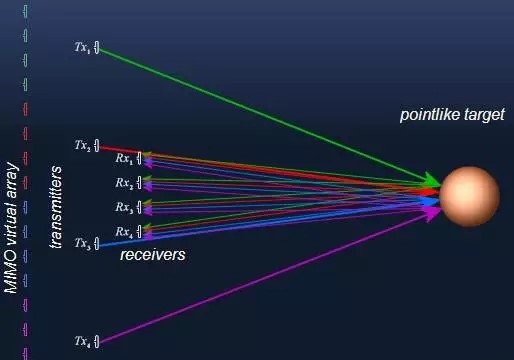
For example, a radar with three transmit antennas and four receive antennas may produce up to twelve transmitter–receiver observations under a suitable antenna layout and waveform scheme. This does not mean that it has twelve independent physical antennas, but it allows the signal processor to work with a larger set of spatial samples.
What Is a Virtual Antenna Array?
A virtual antenna array is the effective array created by combining the positions of the transmitting and receiving antennas.
For each transmitter–receiver pair, the received signal contains a phase relationship associated with the target direction. When the physical antenna geometry is designed correctly, these pairs create different virtual phase centres.
The radar can process the virtual channels together to estimate the angle of arrival of the reflected signal.
A larger virtual array may provide:
- More spatial samples
- Improved angular resolution
- Better separation of targets at similar ranges
- Azimuth and, in some designs, elevation estimation
- More detailed radar point-cloud information
However, virtual channel count should not be confused with usable aperture. Angular performance also depends on antenna spacing, aperture size, signal-to-noise ratio, calibration, target reflectivity and the selected estimation algorithm.
Duplicate virtual positions or unsuitable antenna spacing may provide less benefit than the headline channel count suggests.
A Typical MIMO Radar Processing Chain
An FMCW MIMO radar commonly processes its measurements in the following stages:
- Signal transmission and sampling
The radar transmits a sequence of frequency-modulated chirps and records the returned signals through its receive channels. - Range processing
A range FFT separates reflections according to propagation delay and estimates the distance of each potential target. - Doppler processing
Measurements from multiple chirps are processed to estimate radial velocity. - Transmit-channel separation
The processor separates signals associated with the different transmit antennas according to the selected MIMO modulation scheme. - Target detection
Detection algorithms such as CFAR identify signal peaks that are likely to represent physical targets. - Angle estimation
Phase relationships across the virtual array are processed to estimate azimuth and, where supported, elevation. - Clustering and tracking
Related detection points are grouped and associated over time to produce target IDs, coordinates, speed and trajectories.
The final output depends on the radar design. Some sensors provide a point cloud, while traffic radars may output tracked vehicles, lane statistics, speed, coordinates and traffic-flow data.
TDM-MIMO and Moving Targets
TDM-MIMO activates different transmit antennas at different times. It is widely used because the transmit channels can be separated relatively efficiently.
However, a moving target changes phase during the interval between transmissions. If this additional Doppler-related phase is not compensated, it can affect the virtual array and produce an incorrect angle estimate.
A complete TDM-MIMO processing chain therefore needs to consider:
- Transmit timing
- Target Doppler
- Phase compensation
- Velocity ambiguity
- Antenna gain and phase calibration
This is particularly important in traffic and automotive applications, where targets may move quickly and accurate lane association is required.
MIMO Radar vs Phased-Array Radar
MIMO radar and phased-array radar both use multiple antennas, but they are not identical.
A phased-array radar normally drives multiple transmit elements coherently and controls their relative phase to steer or shape the transmitted beam.
MIMO radar transmits distinguishable signals from different antennas and then combines the transmitter–receiver paths to form a virtual receiving array.
In practice, a radar can use both approaches. A system may apply transmit beamforming in one operating mode and MIMO processing in another. Therefore, “MIMO” and “phased array” should not always be treated as mutually exclusive product categories.
How Does MIMO Radar Estimate Target Angle?
Angle estimation is based primarily on the phase differences measured across the antenna array.
Common processing methods include:
- Conventional beamforming
- Angle FFT processing
- Phase-comparison methods
- MUSIC
- ESPRIT
- Maximum-likelihood estimation
More advanced algorithms may distinguish targets that conventional beamforming cannot separate, but they usually require additional processing resources and reliable calibration.
Actual angular resolution and angular accuracy are also different specifications. Resolution describes the ability to distinguish two nearby targets, while accuracy describes how closely the estimated angle matches the target’s true direction.
Advantages of MIMO Radar
Improved target separation
A larger effective aperture can help the radar distinguish vehicles or people positioned at similar distances but different angles.
Multi-object tracking
Additional spatial information supports the association and tracking of multiple moving targets in complex scenes.
Compact antenna implementation
A virtual array can provide more spatial observations without requiring an equally large number of physical receive channels.
Flexible spatial sensing
Different antenna layouts can be designed for azimuth-only sensing or combined azimuth and elevation measurements.
Better input for system-level decisions
Range, velocity, angle and trajectory information can be supplied to traffic controllers, analytics platforms, cameras or security-management systems.
Limitations of MIMO Radar
MIMO processing does not automatically improve every radar specification. Important limitations include:
- Calibration errors between antenna channels
- Additional processing and memory requirements
- Motion-induced phase errors in sequential transmission schemes
- Mutual coupling and isolation between antennas
- Multipath reflections from roads, barriers and buildings
- Grating lobes caused by unsuitable antenna spacing
- Reduced performance for weak or partially obscured targets
Increasing the virtual channel count does not by itself guarantee longer detection range. Range still depends on transmitted power, antenna gain, receiver sensitivity, waveform parameters, target radar cross-section and environmental conditions.
MIMO Radar in Traffic Monitoring
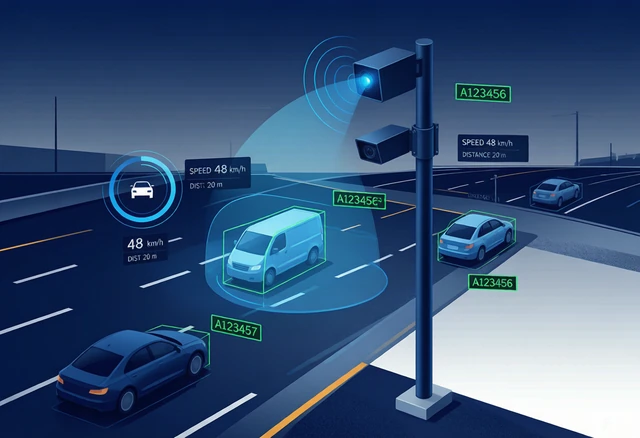
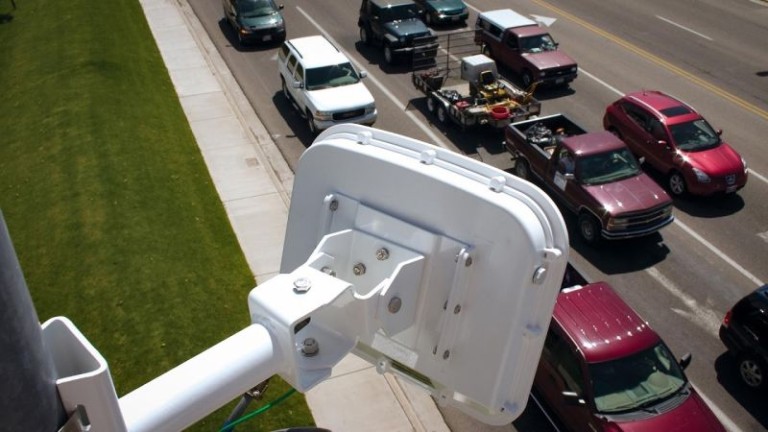
Traffic monitoring requires a radar to separate multiple vehicles, associate targets with lanes and maintain stable tracks as traffic density changes.
MIMO and virtual-array techniques can contribute to:
- Multi-lane vehicle detection
- Vehicle position and speed measurement
- Queue and congestion monitoring
- Lane-level target association
- Wrong-way or stopped-vehicle detection
- Traffic-flow statistics
- Radar and camera fusion
For a complete system, integrators must also evaluate tracking capacity, update rate, coverage geometry, interfaces and the format of the target data.
Our traffic flow monitoring radar solution explains how target-level radar data can support traffic monitoring and control platforms.
For projects that require long-distance, multi-lane vehicle data, the HC-M250 long-range traffic radar can be evaluated according to its published detection range, target capacity, traffic outputs and Ethernet interface. Product selection should be based on the complete application requirements rather than the MIMO label alone.
MIMO Radar in Other Applications
MIMO radar is also used in:
Automotive sensing
Automotive radar uses spatial information for object detection, adaptive cruise control, collision warning, blind-spot monitoring and automated-driving functions.
Perimeter security
Radar can detect and track people or vehicles around restricted areas. Angle information helps locate the target and guide a camera or security platform.
Industrial sensing
MIMO techniques can support robot perception, area monitoring, object localisation and contactless measurement.
Imaging radar
High-channel-count systems can produce denser spatial measurements. Read our explanation of 3D radar technology to understand the relationship between range, azimuth and elevation sensing.
What Should You Check When Selecting a MIMO Radar?
Do not compare products using virtual antenna count alone. Ask the supplier for the specifications that affect the real application:
- Number of physical transmit and receive channels
- MIMO waveform or multiplexing method
- Effective antenna aperture
- Azimuth and elevation field of view
- Angular resolution and angular accuracy
- Detection and tracking range
- Maximum target capacity
- Data update rate
- Output data and communication interface
- Calibration and temperature compensation
- Performance under the intended mounting geometry
For traffic projects, also confirm the number of lanes, vehicle directions, installation height, required target outputs and whether the radar is intended for monitoring or legal speed enforcement.
Frequently Asked Questions
What does MIMO mean in radar?
MIMO means multiple input multiple output. Multiple transmit and receive channels are combined to obtain additional spatial measurements.
Does MIMO radar always have better range?
No. MIMO mainly supports spatial sampling and angle estimation. Detection range depends on the complete radar hardware, waveform, antenna gain, processing and target conditions.
What is a virtual antenna?
A virtual antenna is an effective measurement position created from a transmitter–receiver pair. Multiple pairs can form a virtual array for angle processing.
Is MIMO radar the same as phased-array radar?
No. A phased array normally uses controlled phase relationships to steer a transmitted or received beam. MIMO radar uses distinguishable transmit signals to form virtual channels. Some systems combine both techniques.
Why does MIMO radar need calibration?
Angle estimation relies on accurate phase relationships between channels. Manufacturing variation, antenna layout, cables, temperature and electronics can introduce gain or phase differences that need compensation.
Is MIMO radar suitable for multi-lane traffic monitoring?
It can be, but MIMO architecture alone is not enough. The radar must also provide suitable range, field of view, target capacity, tracking performance, lane association and system interfaces.
Conclusion
MIMO radar uses multiple transmit and receive channels to create a virtual antenna array and collect more spatial information about detected targets.
Its main benefits are improved angle estimation, target separation and multi-object sensing. Its real performance still depends on antenna geometry, calibration, waveform design, signal processing and installation conditions.
When evaluating a MIMO radar, focus on the data and performance required by the final system—not only the number of virtual channels stated in the specification.