Radar resolution describes the ability of a radar system to separate targets that are close to each other.
A radar may detect two vehicles at long distance but report them as one target if their range, velocity and angle differences are smaller than the system can resolve. A different radar may separate the same vehicles into two stable tracks.
This distinction is important in multi-lane traffic monitoring, perimeter security and other multi-object environments. Maximum detection range alone does not indicate whether the radar can distinguish adjacent vehicles, separate a pedestrian from nearby clutter or maintain individual identities in dense traffic.
Radar resolution must therefore be evaluated in several dimensions:
- Range resolution
- Velocity resolution
- Angular resolution
- Elevation resolution, when supported
- Effective multi-target resolution after signal processing
These characteristics are related but controlled by different parts of the radar design.
Resolution Is Not the Same as Accuracy
Resolution and accuracy are frequently confused.
Resolution
Resolution describes whether two nearby targets can be represented as separate detections.
For example, if two vehicles are one metre apart in range, can the radar distinguish them as two objects, or will their reflected signals merge?
Accuracy
Accuracy describes how close a measured value is to the target’s true value.
A radar may separate two vehicles successfully but report both positions with a small measurement error. Conversely, it may estimate the average position accurately while failing to separate the two targets.
Precision
Precision describes the repeatability or stability of repeated measurements.
A measurement can be precise but biased, meaning it repeatedly produces similar results that are offset from the true value.
Digital Bin Size
FFT processing divides radar data into range, velocity and angle bins. Bin spacing describes the sampling grid in the processed spectrum.
A smaller displayed bin size does not automatically mean the radar has improved physical resolution. Zero-padding can create more interpolated FFT points, but it does not add new measurement information or necessarily separate two unresolved targets.
Datasheets should therefore distinguish:
- Physical resolution
- Measurement accuracy
- Repeatability
- FFT bin spacing
- Reported output precision
Range Resolution
Range resolution is the minimum distance difference at which two targets at similar angles and velocities can be distinguished.
For a conventional FMCW radar, the theoretical range resolution is approximately:
Range resolution = speed of light ÷ twice the swept bandwidth
Written in symbolic form:
ΔR = c / 2B
Where:
- ΔR is range resolution
- c is the speed of light
- B is the FMCW sweep bandwidth
A larger modulation bandwidth produces finer theoretical range resolution.
For example, increasing bandwidth allows two reflectors at similar distances to create more distinguishable beat-frequency components.
Frequency Is Not Bandwidth
Operating frequency and bandwidth are different.
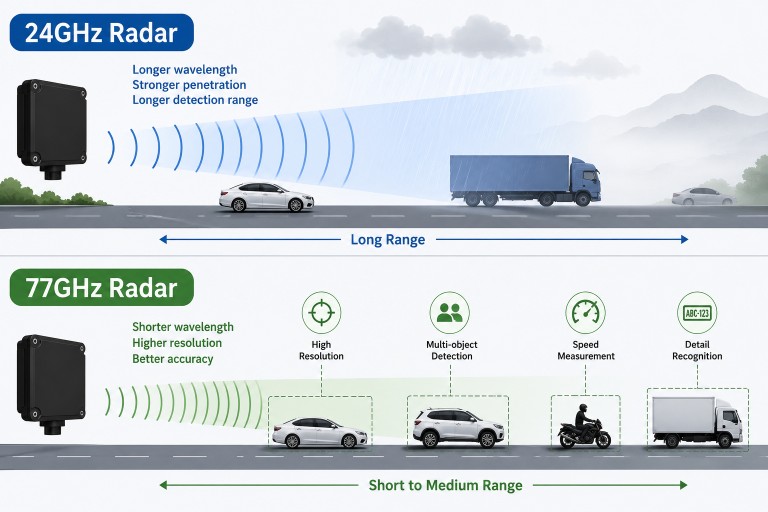
A radar operating at 77 GHz does not automatically have better range resolution than a radar operating at 24 GHz. Resolution depends on the bandwidth actually swept or processed.
A high-frequency radar may have access to wider regulatory bandwidth and smaller antennas, but the usable waveform bandwidth still determines conventional FMCW range resolution.
When comparing radar sensors, check:
- Operating-frequency band
- Usable sweep bandwidth
- Specified range resolution
- Range accuracy
- Minimum detection distance
- Waveform and processing mode
Do not infer resolution from centre frequency alone.
Factors Affecting Practical Range Resolution
The theoretical bandwidth equation is an important starting point, but real-world target separation also depends on:
- Signal-to-noise ratio
- Window function
- Target reflectivity
- ADC sampling
- Frequency-sweep linearity
- Phase noise
- Calibration
- Multipath reflections
- Processing algorithm
- Difference in target signal strength
Two equal reflectors are easier to separate than a weak pedestrian standing close to a highly reflective truck.
Sidelobes from the stronger target may hide the weaker return even when their nominal separation exceeds the theoretical resolution.
Range Accuracy
Range accuracy describes the error in the estimated distance of a target that has already been detected.
It can be influenced by:
- Signal-to-noise ratio
- Frequency linearity
- Calibration
- Target shape
- Multipath
- Estimation algorithm
- Mounting geometry
A radar may use peak interpolation or other estimation methods to locate a single target more accurately than the width of one FFT range bin.
This does not mean that it can separate two targets spaced by the same small distance. Estimating one peak and resolving two peaks are different problems.
Velocity Resolution
Velocity resolution describes the minimum difference in radial velocity required to separate two targets at similar range and angle.
FMCW radar typically measures velocity by analysing phase progression or Doppler frequency across multiple chirps.
In simplified terms, velocity resolution improves when the radar observes the target for a longer coherent time.
A commonly used relationship is:
Velocity resolution is approximately proportional to wavelength divided by twice the coherent observation time.
This means that longer observation time can provide finer Doppler separation.
However, longer observation time may also affect:
- Output update rate
- Response latency
- Maximum unambiguous velocity
- Sensitivity to target manoeuvres
- Processing load
Radar waveform design is therefore a balance rather than a single maximisation problem.
Velocity Resolution Versus Velocity Accuracy
Velocity resolution determines whether two targets with different speeds can be separated.
Velocity accuracy determines how close the reported speed is to the target’s true radial speed.
Consider two vehicles at the same range:
- Vehicle A travels at 70 km/h.
- Vehicle B travels at 71 km/h.
A radar with insufficient velocity resolution may report one combined Doppler component. A different radar may separate both components but still report each speed with a small error.
As with range, resolution and accuracy should not be used interchangeably.
Maximum Unambiguous Velocity
The time interval between chirps influences the maximum radial velocity that can be measured without ambiguity.
If phase changes too far between observations, different velocities may produce indistinguishable sampled phase patterns. This is similar to aliasing in other sampled systems.
Waveform designers must balance:
- Maximum measurable velocity
- Velocity resolution
- Detection range
- Chirp duration
- Number of chirps
- Frame update rate
Advanced waveforms and ambiguity-resolution algorithms can extend performance, but their assumptions and limits must be verified.
Angular Resolution
Angular resolution describes the minimum angle difference required to distinguish two targets at similar range and velocity.
Unlike range resolution, angular resolution is primarily related to the antenna aperture and array geometry.
A larger effective aperture generally produces a narrower beam or more precise direction-of-arrival separation.
Important factors include:
- Number of receive channels
- Number of transmit channels
- Antenna spacing
- Physical aperture
- Virtual MIMO aperture
- Array geometry
- Signal-to-noise ratio
- Calibration
- Direction-of-arrival algorithm
- Sidelobe control
Adding antenna channels can improve angular information, but only when the array is designed and calibrated correctly.
Angular Resolution and Lane Separation
Angular resolution is especially important for roadside traffic radar.
At long distance, a small angular difference represents a large lateral separation. Closer to the radar, adjacent targets may occupy very different angular positions.
For lane-level monitoring, the radar must distinguish vehicles that may have:
- Similar range
- Similar speed
- Adjacent lateral positions
- Overlapping radar reflections
Angular resolution, mounting position and tracking algorithms all contribute to correct lane assignment.
A quoted angular resolution alone does not guarantee reliable lane discrimination. The road geometry and target distance must also be considered.
Field of View and Angular Resolution
Field of view describes the angular area in which the radar can detect targets.
Angular resolution describes its ability to separate nearby directions.
A wide field of view does not automatically provide fine angular resolution. It may require more antenna elements or a more complex array to maintain good separation across the full coverage area.
Design trade-offs can include:
- Field of view
- Antenna gain
- Angular resolution
- Detection range
- Sidelobe level
- Hardware cost
- Processing complexity
Projects should evaluate performance across the required field of view, not only near the sensor’s central axis.
Azimuth and Elevation Resolution
Azimuth is the horizontal angle of a target. Elevation is its vertical angle.
Many traffic radars focus mainly on azimuth because lane separation occurs in the horizontal road plane.
A radar with a two-dimensional antenna array may also estimate elevation. This can support:
- Height separation
- Complex road geometry
- Bridges and slopes
- Object-shape estimation
- 4D radar processing
- Improved clutter rejection
Elevation information requires suitable vertical aperture and calibration. The label “4D radar” does not by itself specify how fine the elevation resolution is.
MIMO Radar and Virtual Aperture
Multiple-input multiple-output radar uses several transmit and receive antenna channels to create a larger virtual array.
For example, combinations of transmit and receive channels can generate multiple virtual antenna positions without requiring a separate receiver chain at every virtual location.
A larger virtual aperture can improve angular resolution and target separation.
However, MIMO processing introduces practical considerations:
- Transmit-channel separation
- Timing
- Phase calibration
- Target motion during the transmit sequence
- Mutual coupling
- Array geometry
- Processing complexity
- Ghost or ambiguous detections
The number of virtual channels is useful information, but it does not fully describe usable angular performance.
Beamforming and Direction-of-Arrival Estimation
Conventional beamforming combines signals from antenna elements to estimate target direction.
FFT-based angular processing is computationally efficient and commonly used in embedded radar systems.
Higher-resolution algorithms may include:
- MUSIC
- ESPRIT
- Maximum-likelihood estimation
- Sparse reconstruction
- Compressed-sensing methods
These techniques may distinguish targets more finely than conventional FFT processing under favourable conditions.
They do not create unlimited resolution. Their performance can be sensitive to:
- Low signal-to-noise ratio
- Calibration errors
- Correlated reflections
- Incorrect target-number assumptions
- Multipath
- Model mismatch
- Limited processing resources
A laboratory demonstration should not automatically be treated as guaranteed field performance.
Windowing and Sidelobes
FFT processing often uses a window function to reduce spectral sidelobes.
Without suitable windowing, a strong target can produce sidelobes that mask a nearby weaker target.
Windowing creates a trade-off:
- Lower sidelobes improve weak-target visibility near strong targets.
- A wider main lobe may reduce the ability to separate targets at similar strength.
- Signal amplitude and noise behaviour also change.
There is no single window that is optimal for every situation. Selection depends on whether the priority is close-target separation, dynamic range or measurement stability.
Dynamic Range and Unequal Targets
Multi-object resolution is harder when targets have very different reflection strength.
A large truck can generate a much stronger return than a motorcycle, cyclist or pedestrian. The weaker target may be hidden by:
- Main-lobe overlap
- Sidelobes
- Receiver saturation
- Clutter
- Multipath from the stronger object
A useful multi-object test should include targets of different sizes and reflectivity, rather than only two identical corner reflectors.
Extended Objects
Vehicles and people are not ideal point targets.
A high-resolution radar may receive several reflections from different parts of one vehicle:
- Front surface
- Corners
- Wheels
- Side panels
- Cargo
- Underbody structures
The radar processor must decide whether these detections represent one extended object or several separate targets.
Higher physical resolution can produce more information, but it also makes clustering and object modelling more complex.
If clustering splits one vehicle into multiple objects, the system may report duplicate targets. If clustering is too broad, two nearby vehicles may be merged.
Resolution and Radar Object Tracking
Detection resolution affects the measurements supplied to the tracker.
The tracking stage then uses information across time to improve continuity and target identity.
Tracking can help:
- Separate trajectories with different motion
- Maintain targets during short missed detections
- Smooth noisy measurements
- Associate targets with lanes
- Reject temporary clutter
- Recover after partial occlusion
Tracking cannot fully restore information that the radar never resolved. If two vehicles produce one indistinguishable measurement for an extended period, the tracker has limited evidence for maintaining two correct objects.
Read more in Radar Object Tracking: From Raw Detections to Stable Target Tracks.
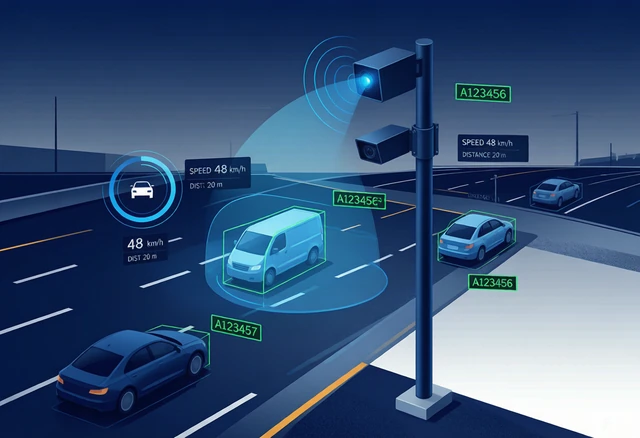
Multi-Object Resolution in Traffic Monitoring
Traffic monitoring creates demanding multi-target situations.
Examples include:
- Vehicles travelling side by side
- Stop-and-go congestion
- Motorcycles passing close to cars
- Trucks obscuring smaller vehicles
- Vehicles changing lanes
- Dense queues at intersections
- Crossing traffic
- Curved roads and ramps
The radar must separate targets and maintain stable lane assignment.
Useful evaluation criteria include:
- Adjacent-lane separation
- Track continuity
- ID-switch rate
- Lane-assignment accuracy
- Count accuracy
- Speed accuracy
- False-target rate
- Maximum stable target capacity
- Performance in congestion
- Recovery after occlusion
A maximum target-count specification does not prove that all targets can be separated in a dense scene.
Multi-Object Resolution in Perimeter Security
Security radar may need to separate:
- Several people walking together
- A person near a fence
- People and vehicles in the same area
- A moving target near static equipment
- Small targets near highly reflective structures
The system must balance resolution with false-alarm rejection.
High resolution can provide more target detail, but it may also detect additional reflections from vegetation, structures or moving machinery. Tracking, classification and zone logic remain necessary.
Resolution in Radar–Video Fusion
Radar–video fusion associates radar tracks with objects detected in camera images.
Poor angular separation can make association difficult when several vehicles occupy nearby image regions. Poor time synchronisation can also cause the radar and camera to report different apparent positions for the same moving target.
Fusion performance depends on:
- Radar resolution
- Camera calibration
- Coordinate transformation
- Time synchronisation
- Target association
- Processing latency
- Object-tracking continuity
A camera cannot automatically correct radar-resolution limitations, and radar cannot automatically correct all visual occlusion. The fusion system must account for uncertainty in both sensors.
Frequency Resolution and FFT Size
Radar processing converts sampled signals into frequency spectra using an FFT or a related estimator.
Increasing FFT size through zero-padding produces more displayed frequency points. This can improve peak interpolation and visual smoothness.
It does not narrow the underlying physical main lobe or add new independent measurements.
True resolution improvements generally require additional information, such as:
- More waveform bandwidth
- Longer coherent observation
- Larger antenna aperture
- More independent antenna channels
- Better signal-to-noise ratio
- A different waveform
- A validated high-resolution estimator
This distinction prevents misleading claims based only on software display settings.
Can Artificial Intelligence Improve Radar Resolution?
Machine-learning methods can assist with:
- Denoising
- Target classification
- Detection refinement
- Clutter rejection
- Object association
- Super-resolution estimation
- Radar–camera fusion
Their performance depends on training data and operating conditions.
A model trained on one road, antenna or target population may not generalise to a different installation. AI-based processing should therefore be evaluated for:
- Unseen target types
- Weather variation
- Different mounting geometry
- Sensor calibration changes
- Rare edge cases
- False detections
- Processing latency
AI can improve interpretation of radar measurements, but it does not eliminate the physical information limits of the sensor.
How to Compare Radar Resolution Specifications
When reviewing a radar datasheet, request separate values for:
Range
- Range resolution
- Range accuracy
- Minimum and maximum range
- Sweep bandwidth
- Performance for different target types
Velocity
- Velocity resolution
- Velocity accuracy
- Maximum unambiguous velocity
- Update rate
- Observation time or waveform mode
Angle
- Azimuth resolution
- Azimuth accuracy
- Elevation resolution, if available
- Field of view
- Antenna or virtual-channel arrangement
Multi-Object Performance
- Maximum reported targets
- Closely spaced target separation
- Dynamic range
- Behaviour near strong reflectors
- ID stability
- Clustering behaviour
- Output-interface limitations
Specifications should identify test conditions. Values measured with corner reflectors in an open area may not represent dense road traffic.
Field Testing Radar Resolution
A representative field test should evaluate more than one isolated vehicle.
Useful scenarios include:
- Two vehicles at similar range in adjacent lanes
- Two vehicles with similar speed
- A motorcycle close to a truck
- Vehicles overtaking
- Stop-and-go congestion
- Lane changes
- Strong roadside reflectors
- Targets near the edge of the field of view
- Maximum required distance
- Partial target occlusion
Test results should record both detection and tracking performance.
Relevant outputs include:
- Raw or clustered detections
- Object IDs
- Target coordinates
- Speed
- Lane assignment
- Track history
- False targets
- Missed targets
- Target merging and splitting
Video or an independent reference sensor can help verify ground truth.
Resolution Trade-Offs in Radar Design
Radar parameters interact.
Increasing one performance metric may affect another:
- More bandwidth improves range resolution but requires suitable hardware and spectrum.
- Longer observation improves velocity resolution but may reduce update speed.
- Larger aperture improves angular resolution but increases physical size.
- More MIMO channels improve virtual aperture but add timing and calibration demands.
- Stronger filtering reduces false detections but may suppress weak targets.
- Wider field of view increases coverage but can complicate fine angular separation.
A radar should be designed and selected for the actual application rather than optimised around one headline number.
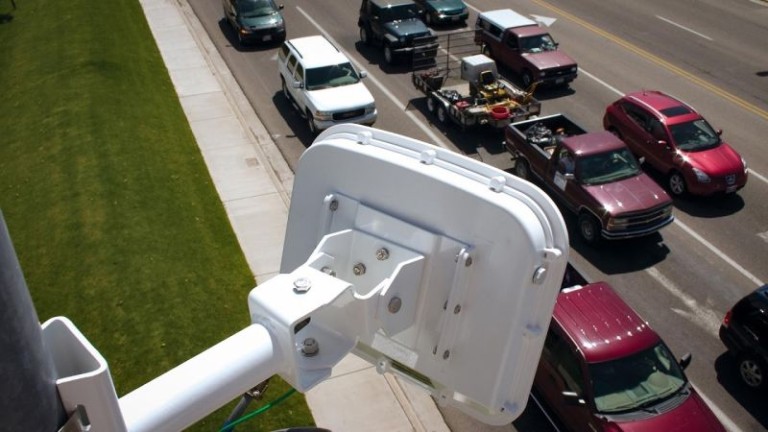
HC-M250 Multi-Target Traffic Radar
The HC-M250 long-range traffic radar is designed for target-level vehicle detection and lane-based traffic monitoring.
Its current configuration supports:
- Detection distance up to 300 metres
- Coverage of up to eight lanes
- Tracking of up to 128 targets
- 70 ms update cycle
- Vehicle position and speed output
- Lane-level traffic statistics
- Ethernet communication
For system integration, these specifications should be evaluated together with:
- Adjacent-lane target separation
- Installation geometry
- Large-vehicle occlusion
- Track continuity
- Lane-assignment stability
- Output latency
- Road curvature
- Maximum required traffic density
The target-capacity number alone does not describe how well closely spaced vehicles can be resolved.
For broader sensor selection guidance, see Radar Sensors Explained.
Frequently Asked Questions
What is radar resolution?
Radar resolution is the ability to distinguish two targets that are close in range, radial velocity or angle.
What determines FMCW range resolution?
For conventional FMCW processing, theoretical range resolution is primarily determined by swept bandwidth. Greater bandwidth produces finer range resolution.
Does 77 GHz radar always have better resolution than 24 GHz radar?
No. Centre frequency alone does not determine resolution. Bandwidth, antenna aperture, waveform and signal processing must also be considered.
What determines velocity resolution?
Velocity resolution is related to wavelength and coherent observation time. Longer observation can improve separation of similar Doppler velocities but may affect latency and update rate.
What determines angular resolution?
Angular resolution depends mainly on effective antenna aperture, wavelength, antenna-array geometry, signal-to-noise ratio and the direction-estimation algorithm.
Is resolution the same as accuracy?
No. Resolution describes whether two targets can be separated. Accuracy describes how close a reported measurement is to the true value.
Does a larger FFT improve physical radar resolution?
Zero-padding a larger FFT can provide finer displayed bins and better peak interpolation, but it does not create additional physical information or automatically separate unresolved targets.
Can software exceed theoretical resolution?
High-resolution estimation algorithms may separate targets more finely than conventional FFT processing under suitable conditions. Performance depends on signal-to-noise ratio, calibration, target assumptions and model accuracy.
Why do two vehicles sometimes appear as one radar target?
Their range, speed and angular separation may be insufficient, one target may mask the other, or clustering may merge their detections.
Does higher resolution always improve system performance?
Not automatically. Higher resolution may increase data volume, clutter sensitivity, clustering complexity and processing demand. The complete detection-and-tracking system must be evaluated.
Conclusion
Radar resolution is multidimensional.
Range resolution depends mainly on waveform bandwidth. Velocity resolution depends on coherent observation time and wavelength. Angular resolution depends strongly on antenna aperture and array geometry.
These physical characteristics interact with signal-to-noise ratio, calibration, windowing, target reflectivity and processing algorithms. Object tracking and classification further influence how the radar output appears to the final system.
The most meaningful evaluation therefore separates resolution from accuracy, repeatability and FFT bin spacing. It also tests realistic multi-target scenes rather than relying on one maximum-range or target-count specification.